
DAYS
HRS
MIN
SEC
The Live Workshop Is Over
But you can join the waitlist for the next one
Systematic Review and Meta Analysis Online Course
Publish Your Systematic Literature Review With Our 7 Week Live Interactive Workshop
Excellent

Based on 1,000 reviews
I just completed a research course
I just completed a research course. The comprehensive content covered multiple
Oleksandra Bohuslavska
Showing our favorite reviews
Comprehensive , clear and concise
This course helped he reengineer my basics and garner two publications in the
Abisshek Raj
My research position is almost there ...
I’m super cinfident now that i can seek a research position the easy and right w…
Zeina Ali
The Live Workshop will start on March 2nd, 2024
Only 3 Spots Available

What does the Systematic Review Course teach you?
HOW TO START
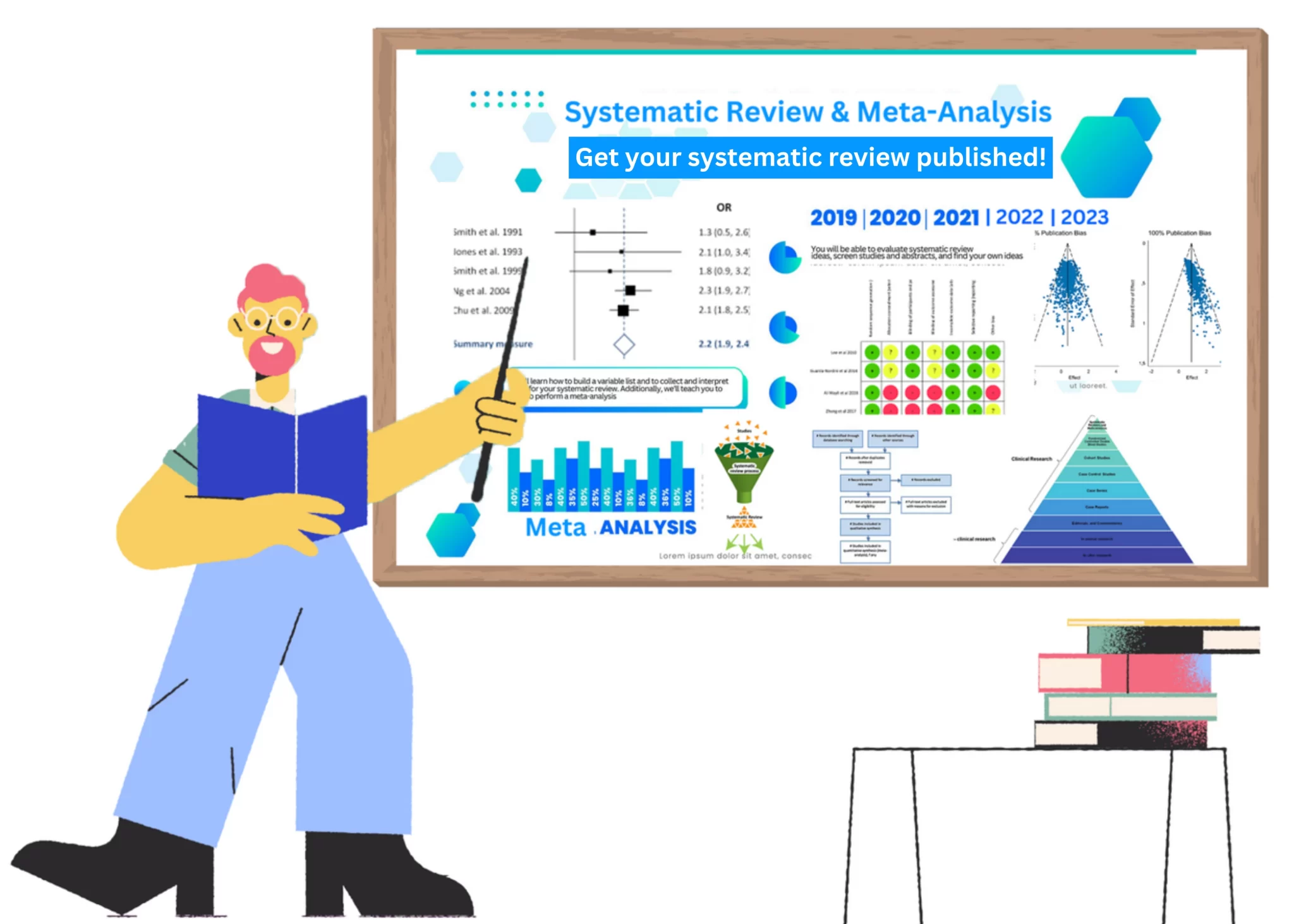
You will be able to evaluate systematic review ideas, screen studies and abstracts, and find your own ideas
MANUSCRIPT WRITING
You will learn the skills required to write a complete manuscript (introduction, methods, results, discussion).
VARIABLES AND DATA
You’ll learn how to build a variable list and to collect and interpret data for your systematic review. Additionally, we’ll teach you to how to perform a meta-analysis
HOW TO BE EFFECIENT
You will learn the secrets on how to efficiently and effectively get your first systematic review published
Our Systematic Review Course Package
Premium
- LIVE Lessons: Full Access
- Recorded Lessons: Lifetime access
- Research and Statistics Courses: Lifetime access
- Research Positions Workshop: Lifetime access
- Access to our Systematic Review WhatsApp Community
- Verifiable certificate
- Risk FREE
$1249 USD
$999 USD
Our Systematic Review Course Packages
Premium
- LIVE Lessons: Full Access
- Recorded Lessons: Lifetime access
- Research and Statistics Courses: Lifetime access
- Research Positions Workshop: Lifetime access
- Access to our Systematic Review WhatsApp Community
- Verifiable certificate
- Risk FREE
$1249 USD
$999 USD
PRO
- LIVE Lessons: Full Access
- Recorded Lessons: 3-month access
- Research and Statistics Courses: 3-month access
- Research Positions Workshop: 3-month access
- Verifiable certificate
- Risk-Free
$999 USD
$699 USD
Starter
- LIVE Lessons: Full Access
- Recorded Lessons: 1-month access
- Verifiable certificate
- Risk-Free
$699 USD
$499 USD
Oleksandra Bohuslavska
I just completed a research course
I just completed a research course. The comprehensive content covered multiple crucial topics in medical research. The exercises were particularly valuable, and
Abisshek Raj
Comprehensive , clear and concise
This course helped he reengineer my basics and garner two publications in the prestigious aesthetic surgery open forum journal ! Thank u dr Malke for the
Zeina Ali
My research position is almost
there now
I’m super cinfident now that i can seek a research position the easy and right way, be ready to handle any task might be landed to me as part of a research
Ali Kimiaei
Very helpful course
Very helpful course. Helped me write numerous research papers. Now I have +10 publications thanks to the fundamental lessons I learned from this course.
Manuel Tovar
Very useful
Very useful, the information provided was really easy to understand, step by step of everything, and all the questions. were answered.
Purvi Kaurani
The webinar on how to find
research position in US
The webinar on how to find research positions in US was very helpful and insightful. The efforts and time taken by Or Fisher were commendable. This was
vrinda pahuja
Research experience simplified!!
Most of my questions were answered by Dr Asaad before I even got the chance to ask them! This session was a good eye opener for me as an IMG without many
Osama
Tells you what to expect and what
you...
Tells you what to expect and what you need to know for US medical residency. Steps, challenges, solutions, for a fair price.
ERUM
Highly recommend
Highly recommend, i had no knowledge how to go about as a not soo internet smart person. This webinar helped me get an insight of whom to approach how to approach adn when to approach.
Fatimah Albahrani
I really like that you bring dr
i really like that you bring dr. james fisher to give us more insight about basic research, thank u sm.
khaled erekat
One of the best sources out
there
One of the best sources out there! It helped me tremendously and I was actually able to put in the work and submit my first solo abstract that got accepted!
Thierry Cyuzuzo
Well organized research training
The contents were very organized and easy to understand in a very short period. You can’t imagine how I improved my research skills after that period.
Mohamad Hussein Alya…
statistcal analysis
I enrolled in the “Medical Statistics for Beginners” course and am currently undertaking the regression analysis course. These courses have proven
ChinYlk Tan
very useful courses for exams
and...
very useful courses for exams and research. advice not easily found elsewhere.
Roba El
Zibaoui
Match Guy Research Webinar
Course Review
Very comprehensive review on how to approach research with a lot of helpful tips. I only wish there was possibility to Collaborate with any of the speakers on
CESAR
Great sessions
All the recommendations and observations have been useful and insightful.
seeme rukh
It was a great experience
It was a great experience. Highly recommended.
Rafael Jimenez
Excellent webinar
Excellent webinar. Very helpful.
komait swaid
Great
Great ! I benefited greatly from this webinar
Mobeena
Very insightful!
Very insightful!
MONEY-BACK GUARANTEE
We are super confident in our course and are willing to back it with a 100% money back guarantee if you are not satisfied!


Get Your Money Back
If Your Are Not Satisfied!
We are super confident in our course and are willing to back it with a 100% money back guarantee! #RiskFREE
Questions About Our Packages?
COURSE
CURRICULUM

The Systematic Review Course
Lesson 1: How to Start a Systematic Review
The first lesson will discuss the early stages of building a systematic review, including answers to the following questions:
• What are the differences between a literature review, a systematic review and a meta-analysis?
• How do I know if my systematic review idea is feasible?
• What is a PICO question?
• What are the steps to create a search strategy?
• Where do I search for studies?
• How do I find research ideas?
• Examples and exercises
Total video length without quizzes and exercises: 1 h 22 min
Lesson 2: Inclusion and Exclusion
The second lesson will go over how to formulate your inclusion and exclusion criteria before you begin sorting through your studies. The lesson will help answer the following questions:
• What is the definition of inclusion and exclusion criteria?
• How do I create a study selection criterion?
• What are common selection criteria?
• Where do I start to generate my search?
• How do I screen my studies?
• Examples and exercises
Total video length without quizzes and exercises: 1 h 6 min
Lesson 3: Variable Selection
The third lesson will cover how to choose your variables for data abstraction. The following points will be discussed:
- Common variables that are used in all studies
- Methods to create your variable list, including different sources
- Examples and exercises in which you will build a variable list for studies
Total video length without quizzes and exercises: 45 min
Lesson 4: Data Collection
This lesson will go over effective methods for data collection and what type of data can be collected. The following points will be discussed:
- Consistency in data collected, including mean + standard deviation vs. frequency + percent
- How to keep your data clean
- Steps in making your life easier for data analysis
- Methodically collecting data to streamline analysis
- Examples and exercises in which you will extract data from studies
Total video length without quizzes and exercises: 49 min
Lesson 5: Conducting Analysis
This is the meat of your systematic review; this will define the value of your systematic review/meta-analysis. The purpose of this lesson is to explain how to easily analyze your data. The following points will be discussed:
• The differences in odds ratio and mean difference
• How to clean up your data to export into a statistical software
• Different statistical programs you can use for analysis
• Examples and exercises on how to perform meta-analysis using statistical programs with categorical and continuous variables
Total video length without quizzes and exercises: 50 min
Lesson 6: Assessing Risk of Bias
Importantly, each study included in a meta-analysis may have a different study design than another. Therefore, authors may want to evaluate each study’s risk of bias so that the pooled results may be interpreted with caution. The following points are discussed:
• Effectively utilize the Newcastle-Ottawa Scale to assess risk of bias for observational studies
• How to evaluate risk of bias for clinical trials
• What is the GRADE assessment for pooled results?
Total video length without quizzes and exercises: 60 min
Lesson 7: Manuscript Writing
Many find manuscript writing the most challenging part of research projects. The purpose of this lesson is to make manuscript writing ridiculously simple and turn it into the most enjoyable part of the research journey. We will cover how to write a manuscript’s introduction, methods, results, discussion, and conclusion in addition to examples and exercises you will be working on
Total video length without quizzes and exercises: 4 h 6 min
The Comprehensive Research Course
Lesson 1: How to Start a Research Project?
This lesson will discuss the preliminary stages of building a research project, including the following topics:
- What are the different study designs?
- What is a research question?
- How to evaluate research ideas?
- How To Find Research Ideas?
- How To Perform A Quick Literature Review?
- How To Perform A Detailed Literature Review?
- What Is The IRB?
- How to submit an IRB?
Total video length without quizzes and exercises: 1 h 50 min
Lesson 2: Variables and Data
This lesson will focus on how to build a variable list for your research project and what you need to do prior to collecting data, including the following topics:
- Finding the patients
- Identifying the variable list
- Choosing the definitions
- Identifying the team
- Identifying the tasks
- Identifying authorship
- Collecting the data
Total video length without quizzes and exercises: 1 h 35 min
Lesson 3: Data is Complete, Now What?
This lesson will discuss how to prepare and interpret your data, including the following topics
- Cleaning the data
- How to make the job of your statistician easier?
- Interpreting categorical data
- Interpreting continuous data
Total video length without quizzes and exercises: 40 min
Lesson 4: Manuscript Writing: Before You Start Writing
Manuscript writing does not have to be daunting. This lesson will go over strategies to help you plan and optimize the manuscript writing process.
Total video length without quizzes and exercises: 18 min
Lesson 5: Manuscript Writing | Introduction
This lesson will discuss the details of how to write the introduction section of the manuscript, including the following topics:
- The outline
- Examples of well-written and poorly written introductions
- Efficiency in writing
- An example of how to start with a draft and the subsequent changes made
- Verb tense
- The gap in knowledge
- The study hypothesis
- Linking words
- Reference managers
- Plagiarism and grammar checks
Total video length without quizzes and exercises: 1 h 6 min
Lesson 6: Manuscript writing | Methods
This lesson will discuss how to write the methods section of the research paper, including the following topics:
- What to include in the methods section
- Tips for writing the methods
- The statistical analysis paragraph of the methods
- Discussion of the methods section using 4 study examples
Total video length without quizzes and exercises: 47 min
Lesson 7: Manuscript writing | Results
This lesson will discuss the details of how to write the results section of the research paper, including the following topics:
- How to create your tables
- Discussion of tables using study examples
- Figures (bar graphs, box plots, Kaplan-Meier curves)
- What to include in the results section
- Tips for writing the results section
- Discussion of the results section using two study examples
- Commonly used verbs and phrases in the results section
Total video length without quizzes and exercises: 54 min
Lesson 8: Manuscript writing | Discussion
This lesson will discuss how to write the discussion section of the research paper, including the following topics:
- The structure of the discussion section and tips for writing an effective discussion.
- The opening paragraph
- Comparison to prior literature (similarities and differences)
- Summarizing prior studies
- Paraphrasing
- Interpretation of your study results
- Implications of your research findings
- Limitations of your study
- Future directions
- Study conclusion
- Discussion of the above-mentioned points using several study examples
Total video length without quizzes and exercises: 1 h 38 min
Lesson 9: Abstracts
This lesson will discuss the details on how to write the abstract for both research papers and conferences, including the following topics:
- Structured vs. unstructured abstracts
- Abstract section
- How to write an abstract
- Visual abstracts
- Conference abstracts
Total video length without quizzes and exercises: 51 min
Lesson 10: Submission and Acceptance
Choosing the right journal is a critical step for your research project. Submission is also a long process, often requiring revision. This lesson will go over the submission process, including the following topics:
- Choosing the right journal.
- What if your manuscript is rejected?
- Responding to reviewers.
Total video length without quizzes and exercises: 57 min
Lesson 11: Poster Presentations
Presenting your research at conferences is essential to increase the visibility of your science, share your findings with the scientific community, and network with clinicians and researchers. This lesson will focus on creating an effective poster presentation, including the following topics:
- Structure of a poster presentation
- Tips on how to create poster presentations
- Poster Examples
- New way of making posters
- How to present a poster
- Poster title
- Poster templates
Total video length without quizzes and exercises: 1 h 21 min
Lesson 12: Literature Review
This lesson will discuss how to write a literature review from beginning to end, including the following topics:
*Note: This lesson is only available for subscriptions of >3 months.
- Steps for writing a literature review
- Systematic review vs. comprehensive literature review
- Tips for writing a literature review
- Defining the question
- Literature search
- The outline
- Writing the introduction
- The structure of a paragraph
- How to write a paragraph for a literature review
- Multiple exercises and assignments
Total video length without quizzes and exercises: 1 h 33 min
Lesson 13: The Peer Review Process
This lesson will go over the process of peer review and how to write a peer review for a research article. The following topics will be discussed:
- Introduction to Peer Review
- How to get started?
- Assessing Research Articles
- Deciding to Accept or Reject a Manuscript
- Examples and Exercises
Total video length without quizzes and exercises: 30 min
Lesson 14: How to publish >20 manuscripts in one year?
This lesson will cover the secrets of being productive during a research year including a detailed discussion of the following:
- Efficiency
- Time management
- Multitasking
- Mentorship
- Teamwork
- Quantity vs. quality
Total video length without quizzes and exercises: 42 min
The Medical Statistics Course
Lesson 1: Introduction to statistical analysis
The first lesson will serve as an introduction to performing statistical analysis. You will also learn how to prepare your data before starting the descriptive and comparative analysis. The following will be discussed in detail:
- How to clean your data
- How to import your data into the statistical software
- Types of variables
- How to organize and code your data
- Formulas
- Combining datasheets
Videos: 2h/40min JMP // 1h/12min SPSS
Exercises: 9 JMP / 9 SPSS
Lesson 2: Descriptive analysis
This lesson will discuss how to describe and visualize your data. The following points will be discussed:
- Descriptive analysis of categorical data
- Descriptive analysis of numerical data
- How to assess normality of data distribution
- When to choose median vs. mean
- 95% confidence interval
- How to perform sub-analysis
- Descriptive analysis from published studies
- How to present your data in a research article
- How to visualize your data using bar graphs, histograms, and box plots
Videos: 1h/52min JMP // 1h/45min SPSS
Exercises: 6 JMP / 6 SPSS
Lesson 3: Hypothesis testing for categorical variables
This lesson will show you how to analyze your categorical variables using both parametric and non-parametric tests. The following topics will be covered:
- Introduction to hypothesis testing
- Chi-squared test
- Fisher’s exact test
- 2×2 table and RxC table
- Relative risk and odds ratio
- Statistical errors
- How to present your data in a research article
- Hypothesis testing for categorical variables from published studies
Videos: 1h/12min JMP // 1h/4min SPSS
Exercises: 7 JMP / 7 SPSS
Lesson 4: Hypothesis testing for numerical variables
This lesson will show you how to analyze your numerical variables using both parametric and non-parametric tests. The following topics will be covered:
- Comparing means of two groups
- T-test and Mann–Whitney U test
- Comparing means of >2 groups
- One-way ANOVA and Kruskal–Wallis test
- Multiple comparisons tests
- Comparing means of two paired groups
- Paired t-test and Wilcoxon signed-rank test
- How to present your data in a research article
- Hypothesis testing for numerical variables from published studies
Videos: 1h/34min JMP // 1h/34min SPSS
Lesson 5: Power analysis and sample size calculation
This lesson will discuss how to calculate the sample size required to achieve statistical significance before you start your research study. The following points will be discussed:
- Introduction to power analysis
- The relationship between sample size, power, standard deviation, and effect size
- How to perform power analysis for two means
- How to perform power analysis for >2 means
- How to perform power analysis for two proportions
Videos: 23min JMP // 26min SPSS
Lesson 6: Simple linear regression
This lesson will discuss how to analyze a numeric predictor and a numeric outcome using simple linear regression and correlation analysis. This lesson will cover the following topics in detail:
- Assumptions of linear regression
- Scatter plots for linear regression
- Methods of linear regression
- Assessing the regression fit
- Adjusted R square
- Standardized and unstandardized beta coefficients
- Correlation analysis: Spearman and Pearson
- Correlation coefficient
- How to present your data in a research article
Videos: 43min JMP // 1h/13min SPSS
Lesson 7: Multiple Linear regression
This lesson will go over analyzing multiple numeric and categorical predictors and a numeric outcome using multiple linear regression. The following points will be discussed:
- Assumptions of multiple linear regression
- Backward, forward, and stepwise model selection
- Assessing the regression fit
- Adjusted R square
- Standardized and unstandardized beta coefficients
- How to present your data in a research article
Videos: 53min JMP // 1h/4min SPSS
Lesson 8: Logistic regression
This lesson will teach you how to analyze multiple numeric and categorical predictors and a categorical outcome using multiple linear regression. We will discuss the following:
- Assumptions of logistic regression
- Methods of logistic regression
- Considerations for numeric predictors
- Odds ratios and 95% CI
- Hosmer-Lemeshow goodness of fit
- How to present your data in a research article
Videos: 1h/2min JMP // 1h/21min SPSS
Lesson 9: Survival analysis
This lesson will go over time-to-event analysis including a discussion of the following:
- Introduction to survival analysis
- Kaplan-Meier curves
- The log-rank test and Wilcoxon test
- Hazard ratio
- Cox proportional–hazards model
- How to present your data in a research article
- Survival analysis from published studies
Videos: 1h/10min JMP // 1h/17min SPSS
COURSE
CURRICULUM
Lesson 1: How to Start a Systematic Review
The first lesson will discuss the early stages of building a systematic review, including answers to the following questions:
• What are the differences between a literature review, a systematic review and a meta-analysis?
• How do I know if my systematic review idea is feasible?
• What is a PICO question?
• What are the steps to create a search strategy?
• Where do I search for studies?
• How do I find research ideas?
• Examples and exercises
Total video length without quizzes and exercises: 1 h 22 min
Lesson 2: Inclusion and Exclusion
The second lesson will go over how to formulate your inclusion and exclusion criteria before you begin sorting through your studies. The lesson will help answer the following questions:
• What is the definition of inclusion and exclusion criteria?
• How do I create a study selection criterion?
• What are common selection criteria?
• Where do I start to generate my search?
• How do I screen my studies?
• Examples and exercises
Total video length without quizzes and exercises: 1 h 6 min
Lesson 3: Variable Selection
The third lesson will cover how to choose your variables for data abstraction. The following points will be discussed:
- Common variables that are used in all studies
- Methods to create your variable list, including different sources
- Examples and exercises in which you will build a variable list for studies
Total video length without quizzes and exercises: 45 min
Lesson 4: Data Collection
This lesson will go over effective methods for data collection and what type of data can be collected. The following points will be discussed:
- Consistency in data collected, including mean + standard deviation vs. frequency + percent
- How to keep your data clean
- Steps in making your life easier for data analysis
- Methodically collecting data to streamline analysis
- Examples and exercises in which you will extract data from studies
Total video length without quizzes and exercises: 49 min
Lesson 5: Conducting Analysis
This is the meat of your systematic review; this will define the value of your systematic review/meta-analysis. The purpose of this lesson is to explain how to easily analyze your data. The following points will be discussed:
• The differences in odds ratio and mean difference
• How to clean up your data to export into a statistical software
• Different statistical programs you can use for analysis
• Examples and exercises on how to perform meta-analysis using statistical programs with categorical and continuous variables
Total video length without quizzes and exercises: 50 min
Lesson 6: Assessing Risk of Bias
Importantly, each study included in a meta-analysis may have a different study design than another. Therefore, authors may want to evaluate each study’s risk of bias so that the pooled results may be interpreted with caution. The following points are discussed:
• Effectively utilize the Newcastle-Ottawa Scale to assess risk of bias for observational studies
• How to evaluate risk of bias for clinical trials
• What is the GRADE assessment for pooled results?
Total video length without quizzes and exercises: 60 min
Lesson 7: Manuscript Writing
Many find manuscript writing the most challenging part of research projects. The purpose of this lesson is to make manuscript writing ridiculously simple and turn it into the most enjoyable part of the research journey. We will cover how to write a manuscript’s introduction, methods, results, discussion, and conclusion in addition to examples and exercises you will be working on
Total video length without quizzes and exercises: 4 h 6 min
Course Instructor

Our course instructor is a current Research Fellow at Harvard Medical School/Massachusetts General Hospital. He has published over 40 articles, of which 20 are Systematic Reviews and Meta-Analysis in top journals across various specialties such as general surgery, vascular surgery, neurosurgery, urology among others.
He graduated from Tecnologico de Monterrey in Mexico, where he led the surgical outcomes research division for a year before joining MGH. He has continued to led international research collaborations across various disciplines while mentoring young researchers and medical students, teaching them the principles of research. He is thrilled to share his extensive research experience with you and help you achieve your research goals

Save hundreds of thousands of dollars 💰!
By investing in research and accelerating your journey towards residency, you have the opportunity to save hundreds of thousands of dollars.
Delaying your Match application and start of residency (due to a weak CV and lack of research) means missing out on the significant salary difference between an attending and a resident (between $200,000 and $600,000).
Investing in this course will boost your CV, enhance your research skills, and increase your chances of matching into residency. Don’t miss out on this opportunity to secure your future success.
Get your Certificate
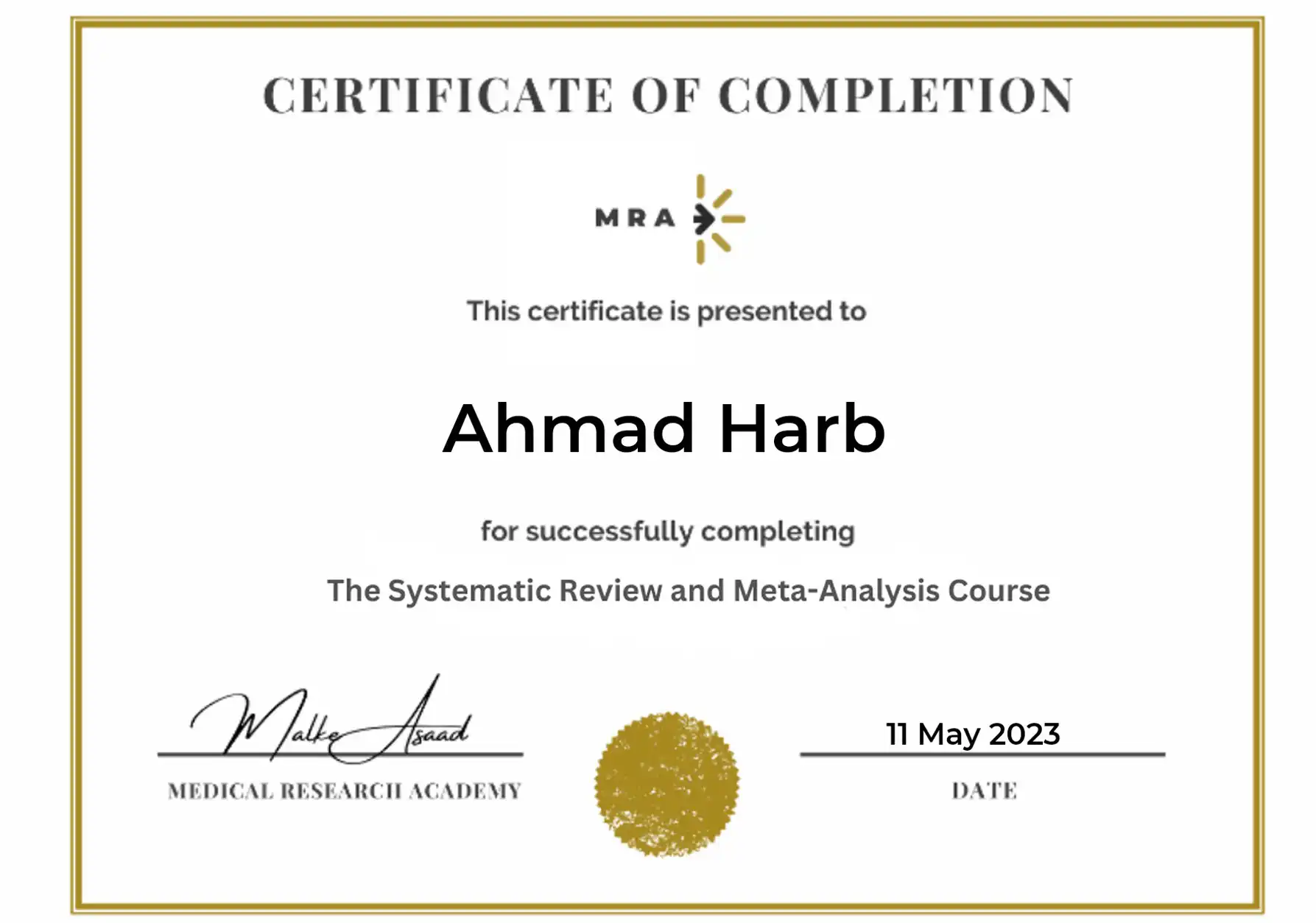
Institutions and program directors can easily verify the authenticity of your certificate, further enhancing your reputation in academic and professional circles. See an example of our student’s verifiable certificate for reference.
Shareable on

Obtain a verifiable certificate that can be shared on LinkedIn and other social media platforms, providing credibility and adding value to your professional profile.

STEPS TO SIGN UP


Step 1
Register for the course now and reserve your seat in the live sessions.
Step 2
Attend the weekly live virtual sessions. Each one hour session will review a specific topic (curriculum summarized below) with interactive exercises and quizzes. At the end of each session, we will answer any questions you have. You will also be given assignments to work on between the live sessions.
Step 3
After course completion, you will have access to the recorded live sessions.


Frequently
Asked Questions
I registered for the course. When do I receive my access to the course content?
You will receive access to the recordings of prior live sessions in addition to a fully recorded version of the Systematic Review Course within 24 hours of your order.
The live lessons of the Systematic Review course will start every few months, conducted through weekly virtual sessions. You’ll get an email with the start dates and times for the live sessions. Following the completion of live sessions, recordings will be made available to revisit the material at your convenience.
When are the live sessions?
The exact dates and times will be shared on this page and emailed to those who signed up. Usually, they’re on weekends at 9 AM Eastern Time. Don’t worry if you can’t attend, you can watch the recorded session later.
Do you have any free preview lessons so I can check out the course before I make the purchase?
Yes, you can check out a free preview of the course HERE.
Do you offer refunds?
My goal is to help you be the best researcher that you can be. If you feel that the course is not helping you, We offer a 100% money back guarantee on all our courses.
Refund Policy: We will give you a full refund if you cancel within 3 days / 72 hours of receiving course access and have completed less than 20% of the course, but once the first live session starts, no refunds are available.
Do you offer any certificates for course completion?
Certificates are available for free. To get the certificate, you must have completed the whole course and have >75% average on the course quizzes.
Are there any materials included in this course other than the videos of each lesson?
Yes. You will have access to the assignments and articles included in this course.
I don't have a good understanding of systematic reviews. Will I be able to comprehend the course content?
Yes. This course is designed to help you learn about systematic reviews and meta-analyses, and take your research project from an idea to publication, even if you don’t have a good background in systematic reviews.
Will I get any publications from this course?
The purpose of this course is to give you the skills necessary to conduct systematic reviews and publish research articles. During the course, we will work with students who have ideas for systematic reviews and guide them as part of students’ examples. However, we do not sponsor any publications as part of this course, nor can we guarantee that your work will be published in a journal.
Does this course cover How to find Research Positions?
Yes, this is included in the premium package of the course and covered in depth in a live and interactive session + you’ll get immediate access to the recordings of the previous sessions.
Systematic Review vs Meta-Analysis
A systematic review is a research method that identifies, evaluates, and synthesizes all available studies on a specific topic. Its goal is to provide a comprehensive and unbiased summary of the evidence. In contrast, a meta-analysis is a statistical technique often conducted as part of a systematic review. It combines quantitative data from multiple studies to calculate overall effect sizes and draw more robust conclusions.
Key Difference:
Systematic Review: Focuses on summarizing qualitative and/or quantitative evidence.
Meta-Analysis: Focuses on statistically analyzing quantitative data to find trends or effects.
Strengths of Using Systematic Reviews for Clinical Research
Systematic reviews offer several advantages for clinical research:
Comprehensive Evidence: They integrate all relevant studies on a topic, reducing bias.
Reliable Decision-Making: Provide high-quality evidence for policy, practice, and guidelines.
Transparency: Employ standardized and replicable methods.
Gap Identification: Highlight areas lacking sufficient research for future studies.
Improved Outcomes: Enhance evidence-based decision-making in healthcare.
Methodology for Systematic Literature Review
A robust systematic literature review involves the following steps:
Define Research Question: Use frameworks like PICO (Population, Intervention, Comparison, Outcome).
Develop a Protocol: Specify inclusion/exclusion criteria and outline search strategies.
Search Databases: Conduct thorough searches in PubMed, Cochrane, or other databases.
Screen Studies: Use tools like PRISMA to filter results based on eligibility criteria.
Data Extraction: Collect key study details such as methods, outcomes, and populations.
Synthesis: Qualitatively or quantitatively analyze and summarize the findings.
Report Results: Publish findings transparently with a focus on reproducibility.
Systematic Review vs Literature Review
Systematic Review: Structured, comprehensive, and uses strict methods to identify and analyze all relevant studies. It often includes a meta-analysis.
Literature Review: Broad overview of a topic without strict methodologies. It may lack reproducibility and comprehensiveness compared to systematic reviews.
Key Distinction: Systematic reviews are highly detailed and aim to eliminate bias, whereas literature reviews are more narrative and exploratory.
Why is a Meta-Analysis Better than Just a Review?
A meta-analysis provides statistical power and reduces uncertainty by:
Combining Results: Pools data from multiple studies to generate more precise estimates.
Resolving Discrepancies: Addresses conflicting findings by averaging results.
Identifying Patterns: Detects trends or effects not apparent in individual studies.
Quantifying Evidence: Provides objective, data-driven insights rather than subjective summaries.
While reviews summarize research qualitatively, meta-analyses add numerical clarity, making them more robust for evidence-based conclusions.
Recommended
Courses

Research
Course
Course
This in-depth course will teach you how to take a research project from idea to publication.
- 14hrs 0m
- 13 Lessons

Medical
Statistics
Statistics
This course teaches you how to independently do your own statistical analysis for research projects.
- 12hrs 33m
- 9 Lessons

How to find Research Positions
This course will demonstrate how to find research positions in the US!
- 3hrs 1m
- live Session