



Cost of living in the US in one of the main considerations for students when pursuing research or residency in the US. In this post, we will cover the different aspects of cost of living in the US and USMLE journey for international students and medical graduates. These costs should be kept in mind when pursuing an unpaid research position or clinical rotation in the US.
Rent is where most of your money will be spent every month and it varies based on the city, location of the house/apartment within the city, and whether you would like to share a place with someone or live by yourself. For example, a one-bedroom apartment in Boston can cost around $3000 a month while a room in a shared house in Rochester, MN can cost $500 a month. If you are looking to save money, try to find roommates or houses where you can rent a room rather than having your own place. Usually institutions have a list of those who rent or a Google sheet for those looking for roommates.
Check out the cities below for general rent prices reported by renters in the U.S., with the average rent in the U.S. being $1,249 a month:
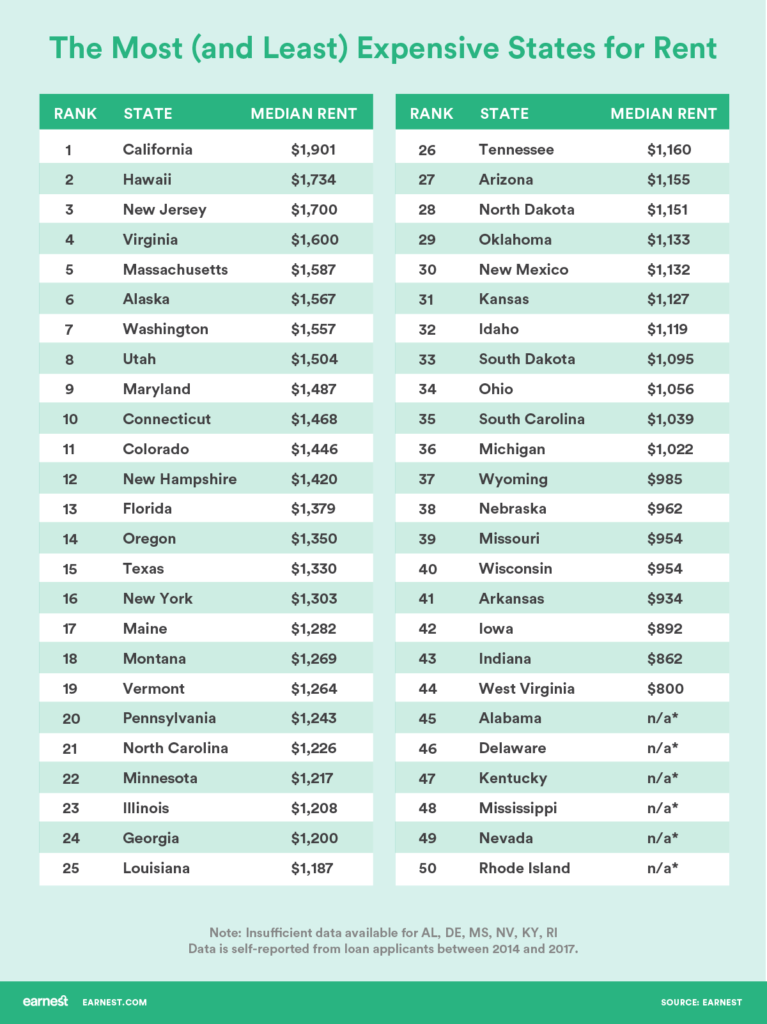
Source: Earnest
See the below image demonstrating relative cost of living in different parts of the U.S. This metric includes everything from rent to groceries to commercial purchases:
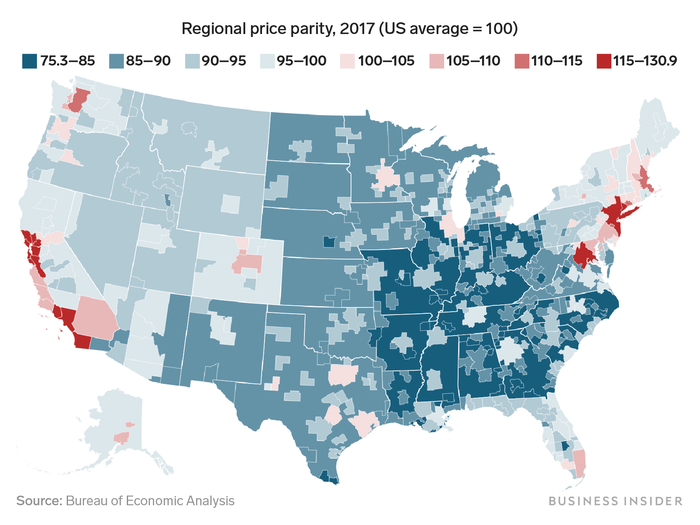
Source:Business Insider
Unless you are planning to stay in one place for more than 4-5 years, renting is almost always the best option. Purchasing a condo/house is an investment that only pays off in the long-term that also comes with its own set of extra effort. For example, most apartment landlords are responsible for any maintenance repairs that may arise while you are living in the apartment. However, if you own your own place and your washing machine breaks down, you are responsible for all costs of replacement.
Apartments.com, Zillow, Facebook Marketplace, and even Craigslist are tools to explore all your options and get a feel for what is a reasonable price range for what you want.
Usually it is best to start apartment shopping around 2 months prior to moving and to sign a contract for a place roughly 1 month out from moving. Most apartments also require proof of renters’ insurance, which ranges from $10-$30 per month. Some apartments offer renters insurance that you can purchase through them, or you can purchase your own insurance through another company.
In addition to rent, there are some common utilities that your landlord should specify in the lease contract:
Food
The price of food doesn’t vary much between cities, but the amount you will spend depends on whether you are looking to make your own food (will cost around $300-500 a month in groceries) or eat out. A fast-food meal can range from $7-15 while eating in a restaurant can cost between $15-30. Of course, you might find more expensive options with some meals going up to over $100 at fancy restaurants.
See the below graph comparing the cost of a gallon of 2% milk in different U.S. cities to get a general idea of the cost of groceries relative to location.
Take a look at this report about retail milk prices.
Some of the cheapest places to get groceries include:
In Houston, TX, one might spend roughly $400 a month on groceries buying ingredients for a new recipe every week as well as basic necessities. Finding a cookbook you like and trying new recipes is a great way to save money while avoiding the temptation to eat out! It also helps to allow oneself a set “weekend” budget for a meal and/or drinks adding up to around $50. ESTIMATED TOTAL COST FOR FOOD: $450/mo.
Commuting
This will depend on whether you are living close to your work or not and whether the city has good public transportation. If the city has good public transportation, it will not be expensive ($70-150/mo). See the below graph comparing monthly costs of public transportation in U.S. cities with the largest number of commuters:
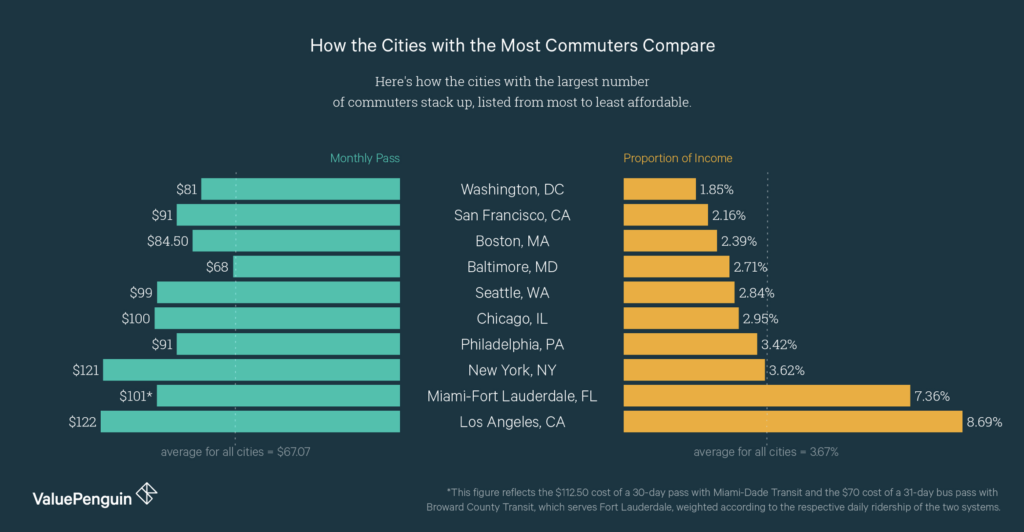
Source: valuepenguin
You might choose to live walking distance to the hospital. However, places near big hospitals are generally more expensive. When shopping for places to live, Google Maps has a “public transport” option that combines walking/bus/metro to find the fastest combination to get in to work each day. This is a great tool to use when shopping for apartments to determine what your commute will be like.
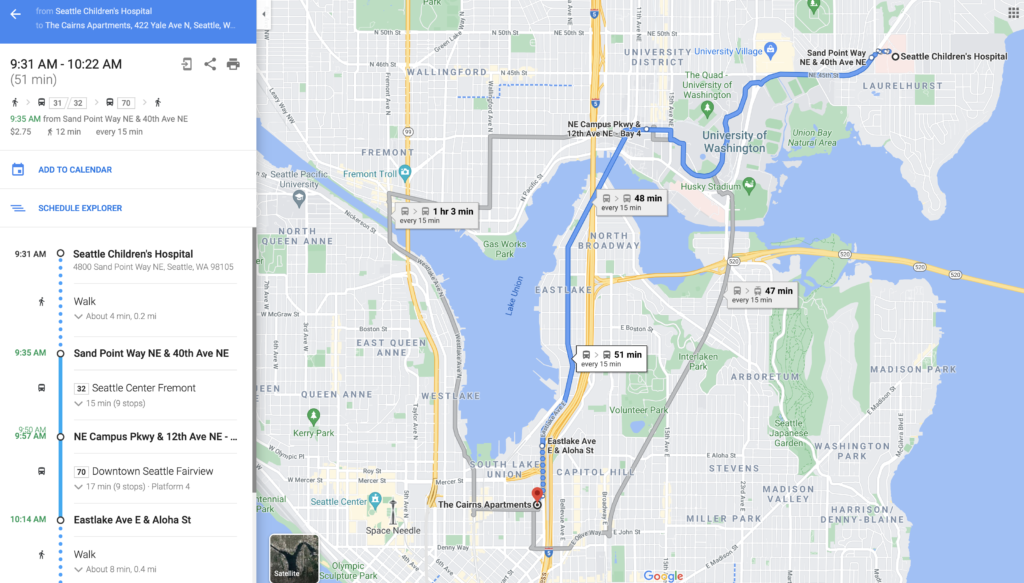
Google.com/maps
If you choose to buy or rent a car, here are some costs to consider:
Finding an apartment close to where you’ll be working and biking in is a great alternative to public transportation. Avoiding traffic jams or depending on public transport to get in to work is nice, and it can be a way to exercise when you’re busy. If it’s raining, you can wear a poncho!
Meetings
If you are in an unpaid position, your mentor might not have enough funds to pay for your travel to scientific meetings which are a good opportunity for you to expand your network within the field. The cost of attending these meetings will depend on the registration fees (sometimes waived for students), flights, and hotels. Generally something between $700-1500 per meeting.
General expenses
It is also important to leave some spending money for things such as clothes, fun activities, cell phone ($30-60 a month), etc., in to maintain a decent quality of life outside of school. Some common monthly expenses might be:

In general, spending a year in the US without a paid position (for research or clinical rotations or school) can cost anything between $12,000 to $40,000. You have to consider that you generally cannot work outside your research if you are on J1 and you will not have a source of income. It is also important to factor in your plane flights to and from the U.S., as these can cost several thousand dollars. Plan wisely and make sure to enjoy the experience.
by Maajid Bhat and Malke Asaad




Our editing includes not only language but also context, structure, and content advising.

The editing goes beyond language and grammar corrections to structure, design, and content advising based on your personal story and achievement.

The best way to learn something is to do it. That’s why we divide our interview preparation sessions into two parts:
Mock Interview + Feedback

We are able to provide you with the guidance you need at any step of your journey to make it to your final goal!