

USMLE Blog

If you want our team’s expert help with your USMLE prep, click here
Updated December 2025
A clear, practical guide to preparing for Step 1 in the pass/fail era.
Preparing for Step 1 no longer requires long lists of resources or complicated study systems. What matters most is understanding core concepts, practicing high-quality questions, and reviewing your mistakes in a structured way. In this blog, we break down the best and minimum resources you need to study for Step 1 in 2026 so you can pass with confidence and build a strong foundation for Step 2 CK.
Stop wasting study time on low-yield content. Our free High-Yield USMLE Step 1 Notes 📚 are designed for efficient learning, helping you quickly master the essential concepts you need to excel, even if you’re studying on a tight schedule.
You can also bundle these notes with our full course, which explains the notes in-depth and covers additional high-yield concepts. Enroll today for USMLE Step 1 prep.
If you need a personalized strategy or one-on-one expert guidance to push past your plateau, we’ve got you covered. Explore Our Expert USMLE Tutoring to get paired with a top-scoring physician and achieve your target score efficiently.
This guide is designed for students who feel overwhelmed by the number of available resources, especially those preparing for Step 1 for the first time. It is also ideal for students who want a strong basic science foundation that will make Step 2 CK significantly easier. The strategies outlined here come directly from what has consistently worked for hundreds of students in recent years.
Before selecting your study materials, take a moment to assess your background. How long has it been since you studied basic sciences? Are you a recent graduate or several years removed from medical school? Was your training in English or another language? How strong is your foundation, and how much time do you have before the exam?
Your answers shape the type and number of resources you should use. Students with a strong foundation can follow a minimalistic approach, while others may need supplemental material to rebuild weak basics.
The transition to pass/fail changed the way students must prepare. Step 1 is now focused on understanding mechanisms, interpreting findings, and applying concepts rather than memorizing long lists of facts. NBME-style reasoning — recognizing patterns and thinking through mechanisms — is far more important than dense memorization.
Because of this shift, passive studying through long videos or textbooks is less effective. Active learning, especially through question-based practice, leads to stronger and more durable improvement.
Even though Step 1 is pass/fail, your performance still matters. Step 1 creates the foundation for Step 2 CK, and weaknesses at this stage almost always resurface later. Good strategy is about using your time efficiently and developing reasoning skills that carry into clerkships, shelves, and Step 2.
Students who perform well typically use UWorld as their main learning tool, keep their resources simple, review mistakes carefully, and check progress periodically with assessments.
UWorld is the primary Step 1 question bank, containing roughly 3,600–3,700 NBME-style clinical vignette questions. It mirrors the real exam more closely than any other resource. Importantly, UWorld is designed to teach you as you go, not simply test your knowledge.
UWorld helps you learn actively by forcing you to think through mechanisms, understand distractors, and build step-by-step reasoning. It also exposes you to common NBME logic patterns. With consistent use, your understanding of basic science and clinical reasoning grows quickly.
Most students benefit from doing blocks in timed non-tutored mode to develop pacing early and simulate the exam experience. Start with system-based blocks since the main goal at this time is learning not self-assessment. You can move on to NBMEs later and switch to random-style questions once you’ve completed the learning phase.
Completing around 60–80 questions per day during dedicated preparation works well for many students.
The most important part of UWorld is the review. Go slowly through the explanations and understand why each answer choice is right or wrong.
Keep your notes short — usually one line per question. Long notes become overwhelming and are rarely reviewed.
Examples:
If you can explain the question and its reasoning to yourself or a friend in under 30 seconds, you’ve learned it. If not, review it again.
Flag questions you guessed, questions you partially understood, and questions covering mechanisms you want to revisit. Review flagged items during the last weeks before your exam.
A deep, thoughtful first pass of UWorld is the single most important part of Step 1 preparation.
For more information about how to study UWorld, check out our UWorld Blog.
TMG Notes are concise, high-yield files created by tutors who scored 260+. They summarize the most frequently tested Step 1 topics in a clear Q&A format designed for rapid active recall. They highlight concepts students commonly miss on NBME-style exams.
The files include:
How to use them:
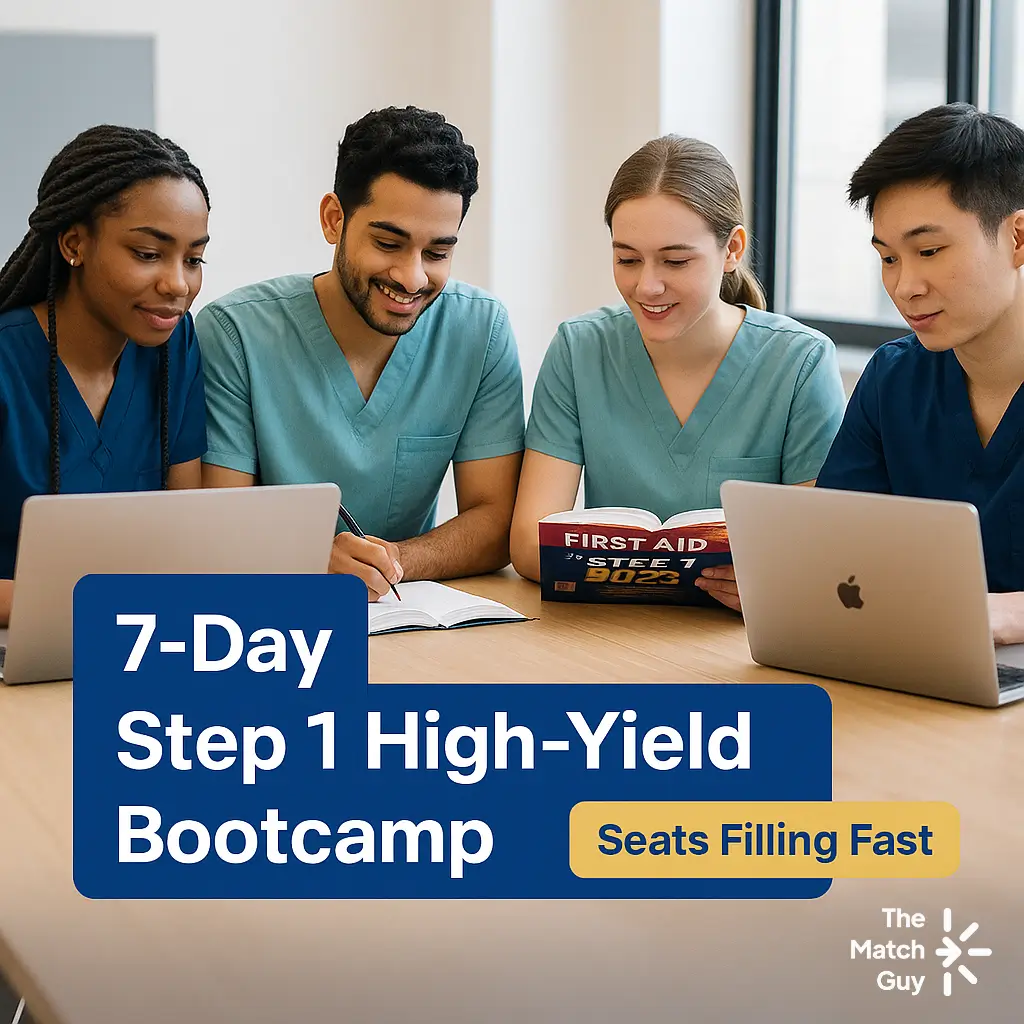
This intensive, live course is designed to complement the free STEP 1 high-yield notes with interactive teaching.
The course is a 7-day live bootcamp, each day is 7 hours of tutoring, covering high-yield topics of every subject tested on STEP 1. You’ll also have the chance to ask questions live and gain access to all session recordings.
Who is this course for?
The course is offered approximately once a month and seats are limited to ensure a more interactive learning environment.
It also comes with a 100% satisfaction guarantee (if you’re not satisfied after the first session, you’ll receive a full refund). That makes it risk-free for USMLE applicants.
You can check the curriculum and sign up HERE.
AMBOSS is a question bank and article library with clear explanations, detailed diagrams, and well-structured flowcharts. It is particularly good for reinforcing physiology, biostatistics, ethics, and clinical algorithms.
Most students do not need AMBOSS. You should only use it after you finish UWorld completely and feel that you still have persistent weak areas despite good UWorld review.
AMBOSS becomes useful if you completed UWorld, reviewed your incorrect and flagged questions, took an NBME, and still scored below passing. At that point, AMBOSS offers fresh questions and targeted reading that can help fill remaining gaps.
Not sure whether UWorld or AMBOSS is the better Qbank for you? Read our full comparison on our blog UWorld Vs. AMBOSS.
Since biostatistics can be challenging to learn through reading alone, this course uses an interactive video format to simplify complex topics. It guides you through practice questions, explains both correct and incorrect answer choices, and helps you decode tricky abstracts and pharmaceutical ads frequently seen on the exam. Not a mandatory resource, but helpful if you are having any difficulty understanding biostatistics.

Although self-assessments are primarily tools to evaluate your progress rather than traditional study resources, they can still be incredibly valuable for learning. These exams are written in a style very similar to the real Step 1, often by the same test authors, which means both the question design and the concepts tested mirror what you’ll see on the actual exam.
After completing a self-assessment under exam-like, timed conditions, the real learning comes from your review. If you got a question right and understood the reasoning — perfect. If you missed it or were unsure how you arrived at the answer, take time to dig into the concept behind it. This process is one of the strongest ways to reinforce knowledge and identify weaknesses.
For NBMEs, where explanations are not provided, you may need supplemental help to break down questions and reasoning. Tools like ChatGPT can help you analyze questions and explore why the correct answer is correct, but you can also seek guidance from tutors if you need deeper clarity. This same approach applies to UW self-assessments, use them not just to test yourself, but to learn from every question.
A short review is enough. For each mistake, identify the concept you missed and whether the error was due to knowledge or test-taking. NBME review should be efficient, not time-consuming.
Students often struggle because they use too many materials at once. This leads to confusion, slow progress, and shallow understanding. A small, consistent resource list is far more effective.
A typical study day might begin with a short review of yesterday’s mistakes. After that, complete your UWorld blocks during your highest-focus hours and spend time reviewing explanations. You can use TMG Notes to reinforce concepts and complete a brief Anki session to review mistakes. This structure keeps study days efficient and prevents burnout.
Check out our Ultimate Step 1 Guide for detailed study structure, strategies, and more.
If you’re preparing while still in medical school, focus on consistency rather than long hours. Completing 20–40 UWorld questions per day provides a strong base over time. Avoid heavy textbook reading and use weekends to catch up if needed.
Anki is most effective when used selectively. It works best for UWorld incorrects, NBME mistakes, microbiology, and pharmacology. Avoid massive decks that take hours per day to maintain. Consider making your own decks.
First Aid Step 1 is an 860-page reference book summarizing nearly all Step 1 topics.
The first half covers general principles such as biochemistry, microbiology, immunology, and pharmacology.
The second half is system-based, covering anatomy, physiology, pathology, and pharmacology for each organ system.
First Aid is a great book and was essential when Step 1 was scored because it consolidated large volumes of rote-memorization material. Today’s exam focuses heavily on mechanisms, reasoning, and NBME-style logic. First Aid does not prioritize concepts, does not explain the “why,” and encourages passive reading — making it inefficient as a main study tool in the pass/fail era.
Kaplan provides detailed textbooks and video lectures for all basic science subjects. While thorough, the content is time-consuming and overly detailed for Step 1 in 2026. Most students prepare more efficiently using question-based tools rather than lengthy lectures.
B&B is a video library explaining foundational basic science concepts in a structured and simple way. It’s helpful for rebuilding weak physiology or pathophysiology, especially for IMGs or students who have been out of school for years.
Pathoma is a pathology review book and video course by Dr. Sattar. It simplifies key pathology mechanisms and is especially helpful for Chapters 1–3 and the hematology section. It’s best used to reinforce pathology — not as a primary Step 1 resource.
Sketchy is a visual mnemonic program that uses illustrated stories to help students memorize microbiology and selected pharmacology topics. It’s most helpful for students who learn visually or struggle with memorization-heavy areas like microbes, antibiotics, and HIV medications.
Atlases such as Netter or Gray’s Anatomy can be used as visual supplements for anatomy-heavy topics. They should not be primary resources — only reference tools when you need clearer anatomical visualization.
This combination is enough for nearly every student to pass Step 1 successfully.
Many students believe they need many resources, lots of videos, or perfect early NBME scores. In reality, Step 1 rewards understanding and consistent question-based learning. Early NBME performance does not predict your final outcome, and memorizing everything is unnecessary in the current exam format.
No. UWorld remains the primary learning tool for Step 1.
No. It is too dense and not prioritized for today’s exam style.
When your last couple of NBMEs are at or above the passing threshold.
Consider delaying only if multiple NBMEs remain below passing despite targeted review.
No. Many students pass without it, but it helps reinforce specific weak areas.
Step 1 preparation does not need to be overwhelming. With consistent question practice, targeted reinforcement, and a small set of reliable resources, you can prepare efficiently and build the foundation you’ll depend on for Step 2 CK. A simple, structured approach remains the most reliable path to success.
If you have any questions about any of our services, don’t hesitate to reach out to our customer support service here.
Good luck on your journey to becoming a future physician!
By Dr. Karim Othman