

If you want our team to help you with your Residency Application, click here.
Step by Step Guide to Couples Matching for Residency
The National Resident Matching Program (NRMP) oversees the residency and fellowship matching process in the U.S. using an algorithm to place applicants into programs based on their preferred rankings.
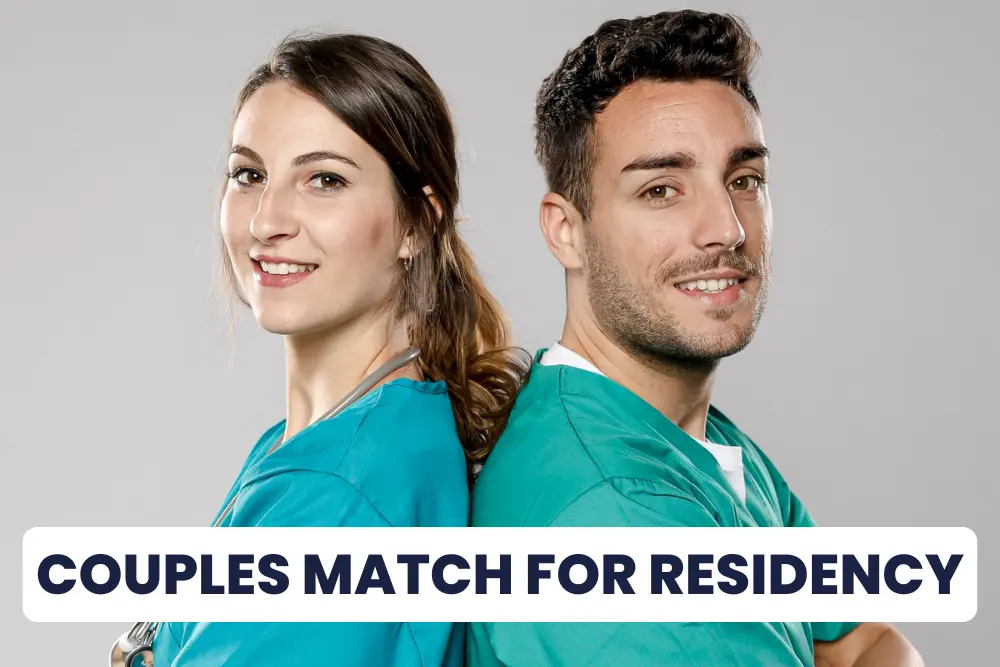
The Couples Match option allows two applicants in the same match to link their rank lists, allowing the algorithm to consider their preferences as a pair. For a couple to match, both applicants must match to a program within the same rank pair—if one applicant doesn’t match at a particular pair, the algorithm moves to the next ranked pair. This means individual rank lists are not considered independently when participating as a couple.
Couples can also include “No Match” options in their rank list, which allows one applicant to match even if the other does not—helping maximize the chances that at least one partner secures a position.

Any two applicants participating in the same match (e.g., Main Residency Match) can register as a couple. You can pair up with anyone—whether it’s your partner, sibling, best friend, or anyone else you want to coordinate with.
Why consider the couples match? It’s ideal for applicants who want to train in the same hospital, city, or region. There are additional potential benefits, including:
Personalized outreach is critical, as generic emails are easy for PDs to overlook. Mentioning your partner’s interview in your email is a compelling and valid reason to request additional consideration.
Participating in the couples match is a major decision and should not be taken lightly. While it offers clear benefits, it can also limit your options if not approached strategically.
Before committing to the Couples Match, it’s essential to have open and honest conversations with your partner about the strength of both applications, individual goals, and priorities throughout the match process. If one partner has a significantly weaker application or is applying to a highly competitive specialty, it could negatively impact your ability to secure interviews.
For example, if you apply to Internal Medicine at Hospital A and your partner applies to Dermatology at the same institution, the Internal Medicine PD may be interested in offering you an interview. However, if the Dermatology program isn’t interested in your partner, the Internal Medicine program might hesitate to move forward with you as well. These inter-program dynamics highlight the importance of early discussions about both partners’ goals, preferred locations, and ideal programs to create a realistic and mutually beneficial strategy.
Once you’ve decided to pursue the Couples Match, the next step is to decide when to disclose your couples match status to programs—either before or after the interview season. Be sure to reflect this choice on your ERAS application prior to submitting.
If waiting until after the interview season, select “No” when asked if you are participating in a couples match in the personal information section of your ERAS application. You will have to select a couples match status on your ERAS application and when registering for the match on the NRMP site. Remember, this can be changed on both platforms up until March, the deadline for rank list submission to the NRMP.
Registering before interview season allows PDs to see your Couples Match status when reviewing applications and scheduling interviews. This approach is especially beneficial for couples with similarly strong applications or the applicant applying to a highly competitive specialty where programs may be more willing to accommodate both applicants if they see them as a strong pair.
Registering after interview season means PDs will not see your Couples Match status unless you choose to disclose it directly via email. This strategy is less likely to affect applicants applying to less competitive specialties, where programs won’t hesitate to extend an interview if your partner’s program has decided to not move forward with their application.
If you’re unsure of which approach works best for your situation, our expert Residency Advisors can guide you through the process and make personalized recommendations after reviewing your application. Book your free consultation today.
Choosing programs is challenging for every applicant—but even more so for couples. Many programs offer “open houses” or zoom information sessions even before ERAS applications open. Asking programs how they consider couples matching can help personalize and inform your strategy throughout the season.
You’ll find that some programs welcome couples match applicants more than others and it’s critical that both applicants apply to these couples-match friendly programs.
Be sure to identify areas with a large density of residency programs and apply to such programs. If one partner can get an interview in this area, it’ll leave the door open for you to connect with all surrounding programs to express your interest and share that your partner has an interview nearby.
Always apply to programs at the same hospital/health system. It may be easier to get an interview at a program within the same hospital that your partner interviewed compared to other programs within the same geographical area.
If you’re an IMG (International Medical Graduate), focus on IMG-friendly programs, which are often also more open to couples matching. Checkout our curated IMG-friendly programs list.
Lastly, apply to programs in areas that either you or your partner has a connection to. For example, apply to programs in cities or states where you completed clinical rotations, attended college, grew up or have family in the area. PDs value this as you have knowledge of the area, know what you’re signing up for, and more likely to rank their program highly if they think you would be a good fit for their program.
The answer to this question is complex and varies depending on several factors:
In general, be prepared to apply to significantly more programs than if you were applying alone.
When executed well, the couples match can enhance your chances of matching by increasing your total interview opportunities. However, the biggest mistake couples make is failing to actively advocate for themselves and each other during the interview season.
Not reaching out to PDs in a strategic way is a missed opportunity to convince them that you’re genuinely interested in joining their program. However, if executed poorly, contacting programs can hurt your application. It’s critical to avoid sending generic or impersonal outreach emails. Instead, share your excitement that your partner has an interview nearby in addition to all the reasons why you think the program can satisfy your personal and professional goals.
Don’t forget that residency programs want to recruit strong applicants, but more importantly, they want residents that will be genuinely happy at their program. For many applicants, having their partner nearby is a huge determinant in being happy within a program. Similarly, advocate for your partner! After accepting an interview invitation, be sure to reach out to your PD and remind them that if given the opportunity, your partner would also love to interview with their respective program within the same hospital.
What happens if your partner doesn’t get an interview nearby at a top program you want to rank? If your partner doesn’t receive an interview at a program you’re highly interested in, reach out to the PD and PC after interview season (in mid-late January). Explain that you and your partner are open to greater distances apart to join a program that aligns well with your professional and other personal goals. This reinforces your enthusiasm and assures programs that distance apart from your partner won’t prevent you from ranking them.
By this point, you and your partner will hopefully have received many interviews and can start building your paired rank list. Before you and your partner start creating your rank list, remind yourselves of the conversations you had at the beginning of the application season when you discussed location, and priorities.
Some tips for building your list:

Do:
Don’t: