




Hello everyone! Welcome to our tutorial and a step-by-step guide on how to write a Case Report.
In theory, every specialty publishes case reports. However different specialties will have different interests in what a case report should include. For example, a case report for a radiology journal will have a different focus than if it was written for a surgical journal. For the former, readership and editors might find details related to radiologic findings to be more interesting than surgical pictures and vice versa.
Additionally, some specialties have dedicated journals to case reports. For example, urology has Journal of Endourology – Case Reports. For Surgery, there are journals such as the Journal of Surgical Case Reports that solely publish case reports.
Like most published literature, case reports follow a structure which typically consists of:
The CARE guidelines are generally regarded as the standard “checklist” for publishing a quality case report and some journals ask for the checklist to be submitted along with the manuscript. Here you can find more information about the CARE guidelines: https://www.care-statement.org/
Once you’ve gauged the literature for the feasibility of publishing, you should gather all the possible case information. You can use the case reports you found as a guide as to what you’ll need, but in general, try to obtain data on:
Case report’s introductions are very similar in structure and purpose to any other published study. The aim of any introduction is to give background about the topic you are presenting. Typically, introductions have 3-4 paragraphs. For case reports, introductions might be 1-2 paragraphs or sometimes even a few lines based on the word limit allowed by the journal. Think of a funnel or an inverted triangle where you go from general/broad to specific. Your prior literature review should help you fill out the paragraphs.
The first paragraph will typically: describe the disease, etiology, and provide brief epidemiologic data in 2-3 sentences. This is usually followed by typical clinical presentations or other related findings/or treatments. In a broad sense, the first paragraph is a very general summary of the background of this condition.
The second paragraph will transition into setting the context as to why your case is important or different. Why there’s a gap or need for this case. Think of it as selling or pitching something. Depending on your case and its focus it will range from a rare presentation or findings to variations in treatments or procedures.
Lastly, your last paragraph is a brief, concise summary of what the report entails, usually something like
“We present a case report of X condition treated successfully with X technique and adequate outcomes”.
When writing your first introduction it’s easy to get overly excited and extend too much. It’s important to stay focused and on-topic. A good rule of thumb is to keep introductions at around 300 words.
Another important point to keep in mind is the context of your readership and make it understandable for a broad readership.
Let’s start with a short introduction that condenses all the above-mentioned points in a single paragraph. The following case report “Dangerous mistake: an accidental caffeine overdose” published in BMJ Case Reports will be our first example.
1st Paragraph
“This case illustrates the life-threatening consequences, such as malignant cardiac arrhythmias, of severe caffeine poisoning, which is a rare event. Also, it highlights the risk of accidental caffeine overdose associated with sports practice, which can be related, not only, to the difficulty in measuring small portions, but also due to unclear consumer’s instructions.”
As we go through examples, you’ll see the various ways introductions or backgrounds can be written to serve specific purposes. In this case, the brief background/introduction is centered on “justifying” the importance of the case.
Abstracted from: Andrade A, Sousa C, Pedro M, Fernandes M. Dangerous mistake: an accidental caffeine overdose. BMJ Case Rep. 2018;2018:bcr2018224185. Published 2018 Jun 8. doi:10.1136/bcr-2018-224185
1st paragraph
“A gallstone ileus is a mechanical intestinal obstruction caused by a gallstone impaction within the gastrointestinal tract. It mainly occurs following the formation of a cholecystoenteric fistula, most commonly in the duodenum and secondly in the colon. A cholecystocolonic fistula (CCF) is a late complication of repeated episodes of chronic inflammation of the…Impaction of a gallstone in the sigmoid colon causing a large bowel obstruction is rare and it’s usually at the sites of previous inflammation or colonic disease”
In this excerpt abstracted from the article, notice how it plays the role of the 1st and second paragraph by introducing gallstone ileus and mentioning how fistulation between the gallbladder and colon are rarer (and later ties down this fact by mentioning that there are only 250 reported cases).
2nd Paragraph
“Here we present a case of a 49-year-old female patient presenting with abdominal pain and bowel obstruction due to a gallstone impaction on the sigmoid colon due to a CCF. No more than 250 cases have been reported; a review of the literature of this rare condition is also revised. The work has been reported in line with the SCARE criteria”
Since the previous paragraph covered the essential functions of the typical paragraphs 1 and 2, in this example, paragraph 2 presents a summary of what will be presented (which is typically paragraph 3)
Alternatively, introductions can be lengthened a bit if needed, as in this example from “Balo’s Concentric Sclerosis with monophasic course: A report of 2 cases” published in Annals of Medicine and Surgery
Watch our video, “How to Write & Publish Case Reports” to learn exactly how to successfully create and publish a high-quality case report:
1st Paragraph
“Balo’s Concentric Sclerosis (BCS) is a rare demyelinating disease considered a variant of multiple sclerosis (MS). It presents acutely with focal neurological deterioration. Magnetic Resonance Imaging (MRI) is the diagnostic modality, which usually reveals concentric lamella in cerebral white matter with “onion-like” lesions…”
2nd Paragraph
“BCS often affects young adults and three different clinical courses have been described; including an acute and self-limiting, remittingrelapsing variant and rapidly progressive primary disease. These last 2’s clinical and radiological characteristics appear to be more strongly related to MS. BCS usually courses with solitary lesions, which may persist for years. These lesions may regress and resemble typical demyelinating plaques.”
3rd Paragraph
“BCS is a variant of MS or separate entity. Prior authors have hypothesized increased risk of progression to MS when multiple bands and/or oligoclonal bands are found. In this report we describe two patients presenting at an academic institution with BCS, which presented with a monophasic course, and characteristic Balo lesions in MRI that disappeared during a long term follow up.”
Abstracted from: Martinez HR, Rodriguez-Gonzalez IC, Escamilla-Garza JM, Figueroa-Sanchez JA, Garcia-Aleman AC, Hinojosa-Gonzalez DE. Balo’s Concentric Sclerosis with monophasic course: A report of 2 cases. Ann Med Surg (Lond). 2021;68:102602. Published 2021 Jul 28.
Further reading/examples:
First human face allograft: early report
https://www.thelancet.com/journals/lancet/article/PIIS0140-6736(06)68935-6/fulltext
Metastatic Cutaneous Apocrine Adenocarcinoma Treated With a Combination of Pertuzumab-Based Targeted Therapy and Taxane Chemotherapy
A Case Report
https://jamanetwork.com/journals/jamadermatology/fullarticle/2436320
Deformation of cranioplasty titanium mesh in a paediatric patient following head trauma
https://pubmed.ncbi.nlm.nih.gov/31189547
“A 32-year-old woman with no significant medical and family history presented to the local emergency department (ED) referring malaise, anxiety, dizziness and nausea. Symptoms like chest pain, syncope, palpitations or fever were denied. The initial physical examination at triage revealed a Glasgow Coma Scale (GCS) of 15, a respiratory rate of 19 breaths/min, 100% oxygen saturation on room air, blood pressure of 112/70mm Hg, pulse of 80 beats/min and had a normal tympanic temperature. Also, the blood sugar was 147mg/dL. After observation, the patient had an episode of presyncope followed by agitation and vomiting. At this point, the patient was pale and sweaty with a GCS of 11 (eye opening: 4; verbal response: 2; motor response: 5), blood pressure of 115/75mm Hg, tachycardia (160 beats/min) and 99% oxygen saturation on room air…”
It is always best to start with presentation and past relevant history. However, it’s important to keep the context of the patient and the journal being submitted to in mind. For example, in this case in the emergency department, blood pressure, heart rate, saturation, GCS are all very important, whereas in a pathology focused case report they might not.
“The initial group of complementary exams was:
► Electrocardiogram (figures 2 and 3) showing a broad QRS polymorphic tachycardia.
► Arterial blood gas showed a metabolic acidosis with pH of 7.296 (7.35–7.45), pCO2 of 29.9mm Hg, pO2 of 117mm Hg, HCO3 of 16.1mmol/L (22–26) and severe lactataemia with serum lactate level of 5.3mmol/L (0.5–1.6).
► Prominent laboratory findings included mild leucocytosis of 13.50×10⁹ /l (4.0–10.0) with 68.3% neutrophils, hyperglycaemia of 254mg/dL (70–105), hypocalcaemia of 2.5mmol/L (3.5–5.1) and hypophosphataemia of 1.8mg/dL (2.3–4.7). Magnesium and calcium serum values were within normal range as well as thyroid, renal and liver function tests. Urinalysis was positive for ketones and glucose and negative for cocaine and opioid drugs.”
Work up should follow on the premises set during the initial presentation and case history. While some patients may have undergone a plethora of tests, try to focus on the ones relevant to the presentation. For example, in this case, treating physicians were working up a possible intoxication as a main diagnosis, in such case if the patient underwent additional unrelated testing (as a ridiculous example, a colonoscopy) it may be better to omit to keep the sections short and concise.
“The supportive treatment, including intravenous fluids, propranolol, potassium and phosphorus supplementations, stabilised the patient’s clinical status. No activated charcoal was administered as the medical team was unaware of a dietary product ingestion during the initial evaluation. After 48hours of observation in our intermediate care unit, the patient was transferred to the ward, since she only had a asymptomatic sinus tachycardia (maximum of 120 beats/min), with other vital signs remaining stable and normal serum pH, lactate and glucose levels.”
“The patient remained in our intermediate care unit for 2 days, with normal level of
Outcomes and follow-up are one of the most important sections of the case report, make
consciousness maintained, normalisation of arterial blood gas values and no recurrence of presyncope episodes. However, she had persistent sinus tachycardia and, for this reason, was submitted to a 3-day course of 30 mg/day oral propranolol with heart rate control. The patient remained clinically stable and 5 days later was discharged asymptomatic referred to internal medicine follow-up… Six months after the episode, at follow-up evaluation, the patient remained asymptomatic.”
sure you include relevant systems/scores and any lingering symptom.
Abstracted from:Andrade A, Sousa C, Pedro M, Fernandes M. Dangerous mistake: an accidental caffeine overdose. BMJ Case Rep. 2018;2018:bcr2018224185. Published 2018 Jun 8. doi:10.1136/bcr-2018-224185
“A 49-year-old female patient was admitted to the hospital with severe abdominal pain, nausea, vomiting, and constipation following a 3- day history of colicky middle abdominal pain. The patient had no relevant medical history. On examination the patient was hemodynamically stable and afebrile. Physical examination revealed abdominal distension with decreased bowel movements to auscultation accompanied by diffuse tenderness to superficial and deep palpation and a tympanic colonic margin to percussion…”
Presentation and relevant history. Notice how it’s focused on relevant aspects to the scenario in which the patient presented (i.e abdominal pain in the E.R. where hemodynamical stability is important vs a case of a rare condition in an outpatient clinic where it might not be as important)
“Laboratories showed a normal hemoglobin, WBC of 6.7 × 10ˆ 10 and no alterations in liver enzymes, except for an elevation in GGT, with a value of 226UL. Simple abdominal radiographs were performed, observing dilated loops of the small bowel, and no signs of gas in the rectum. A CT was ordered, revealing a 3 × 2 cm calcified mass in the sigmoid colon, suggestive of a gallstone, with associated enlargement of the surrounding intestinal wall, with stranding pericolonic fat and signs of diverticular disease…”
Laboratory, imaging and other work-up. Same concept as above, focused on relevant findings for this patient’s scenario.
“The patient underwent an exploratory laparotomy, and after the abdominal cavity was exposed, signs of dilation of the small intestinal loops became evident. An intraluminal, solid, non-mobile mass was found in the sigmoid colon. An enterolithotomy was performed, and a 4 × 4 cm gallstone was extracted without complications, performing a primary transverse closure of the colon. A fistulous track was observed between the gallbladder and the hepatic flexure of the colon…The patient had an adequate postoperative outcome, referring only moderate pain during the first day. Oral intake was reintroduced on the fourth day, without further complications. On the fifth POD the patient was discharged home, with good oral intake and with norma levacuations. “
Treatment and postoperative course. Since this is a surgical-focused case report, operative technique and a thorough description of the procedure are highly encouraged.
“On a 8 month-follow up, the patient is doing well with no biliary symptoms.”
Follow-up.
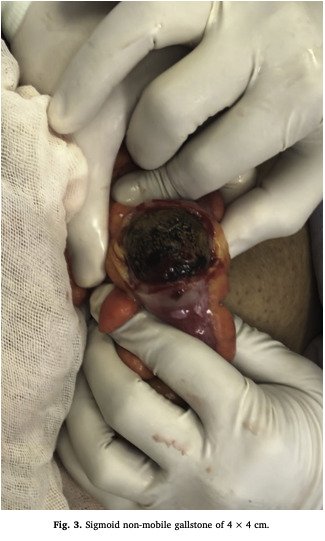
Example image from the case
Abstracted from: Mauricio GU, David Eugenio HG, Enrique QF. Gallstone ileus of the sigmoid colon caused by cholecystocolonic fistula: A case report. Ann Med Surg (Lond). 2018;31:25-28. Published 2018 Jun 6. doi:10.1016/j.amsu.2018.06.001
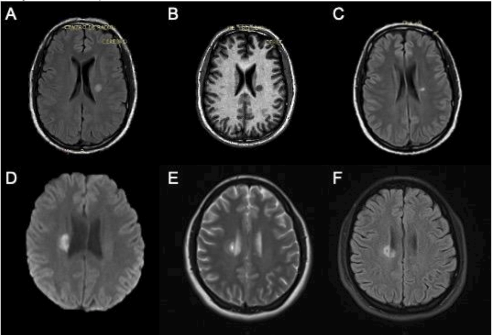
Case 1: “An enhanced MRI showed a periventricular concentric demyelinating lesion in left periventricular area (Fig. 1A and B). Clinical and imagining findings raised suspicion for isolated MS clinical syndrome. A lumbar puncture revealed one OCB, 3 mononuclear cells and normal proteins in CSF. Somatosensorial evoked potentials were compatible with demyelinating disease. “
Case 2: “Stroke protocol MRI revelaed a right sided periventricular concentric demyelinating lesion with a concentric ring pattern that showed enhancement after endovenous contrast injection…The CSF showed normal proteins, no leukocytes and the OCB were negative. “
Case 1: “The patient received IV methylprednisolone (1000 mg/day for 5 days) showing clinical improvement and was discharged 5 days later without any neurological deficit. His neurologist prescribed interferon, once a week subcutaneously that was suspended one month later due to side effects. Case reassessment from a neurologist consulted for a second opinion suggested BCS. “
Case 2: “The diagnosis of BCS was established and the patient received IV methylprednisolone. (1000 mg/day for 5 days) and a remarkable clinical improvement was observed and one week later the patient was discharged.
“
Case 1: “The patient has remained asymptomatic and 10 years later (September 2020). Follow-up MRI revealed small gliosis in the left periventricular area.”
Case 2:
“She remains asymptomatic eight months after diagnosis.
“
Further reading/examples:
First human face allograft: early report
https://www.thelancet.com/journals/lancet/article/PIIS0140-6736(06)68935-6/fulltext
Metastatic Cutaneous Apocrine Adenocarcinoma Treated With a Combination of Pertuzumab-Based Targeted Therapy and Taxane Chemotherapy
A Case Report
https://jamanetwork.com/journals/jamadermatology/fullarticle/2436320
Deformation of cranioplasty titanium mesh in a paediatric patient following head trauma
https://pubmed.ncbi.nlm.nih.gov/3118954
Some authors choose to summarize a study or 2 per paragraph and directly compare those findings to their own study while others prefer to provide a general overview without fixating on any one study specifically.
In this example, authors contrast their case and treatment to that of published literature, sometimes addressing changes in standardized or expected treatment.
“The exact etiology of CCF secondary to gallstone disease may vary. Glenn et al. in their study of a few more than a hundred bilioenteric fistulas, stated that acute inflammation of the gallbladder with obstruction of the cystic duct allows adhesion of the gallbladder to the contiguous organs. This promotes ulceration and ischaemia of the wall of the gallbladder and the adjacent organs, creating an anomalous communication between them…”
Reintroduction of the general context of the case is a great way to set up the discussion which should center on discussing similarities and differences.
“Clinical signs of CCF are usually minimal, and preoperative diagnosis of CCF is rare and only considered in 7.9% of all CCF, therefore the diagnosis is often made intraoperatively. Signs and symptoms of a CCF may vary, as it often presents with abdominal pain, nausea, vomit, diarrhea, weight loss, and malabsorption…”
Clinical presentation as reported in the literature is provided to better assess and contrast how this case was different or similar from the reported literature.
“Gallstone impaction occurs most frequently in the small intestine, followed by the colon in 8% of the cases. In the vast majority of patients presenting with CCF and biliary ileus, the stone is located at the sigmoid colon. The size of the gallstone is presumed to determine whether and where a migrated stone will impact. Small and mid-sized stones are thought to pass through the entire colon, thus being easily expelled through stools; whereas gallstones over 2.5 cm in diameter may cause colonic obstruction at the sigmoid colon…”
Common impaction locations, again, providing in-depth context. As previously mentioned, it’s important to scrutinize the presented case against published literature as much as possible.
“Our patient had diverticular disease and a gallstone of 4 cm, predisposing it to impact at this point. Misdiagnosis is common and it also carries a significant rate of complications with a mortality rate ranging from 12% to 27% in most series reported. Preoperatively diagnosis is therefore critical to improve morbidity, mortality and post-operative complications…”
Possible etiologies
“Treatment of CCF has changed through the years; traditional treatment during the early 80s suggested a ‘‘two-stage’’ procedure, performing a diverting colostomy. Nowadays, a ‘‘one-step’’ management has been considered the treatment of choice without significant complications being reported, versus doing only the enterolithotomy alone…”
Context for treatment and setting up discussion to analyze how frequent is the treatment provided by the authors.
“We opted to perform solely the enterolithotomy because the patient never experienced biliary colic or any other symptoms associated with gallbladder disease. We decided to correct only the occlusion during the laparotomy, as the surgical approach was less complicated, and it had a lower mortality rate. Simple enterolithotomy enthusiasts state the infrequency of recurrent gallstone ileus, and the rarity of complications directly related to a persistent gallbladder fistula, such as cholecystitis, cholangitis, malabsorption and carcinoma of the gallbladder. Also, when the occlusion is resolved, the possibility of spontaneous closure of the fistulous track is higher, leaving behind only a fibrous remnant.”
Rationale for treatment provided by the authors and outcomes.
“Caffeine (1,3,7-trimethylxanthine) is a natural product commonly found in foodstuffs, beverages and medicinal products. When relatively low doses of caffeine are consumed, severe side effects are uncommon. However, in recent years, larger amounts of caffeine have been added to energy drinks or taken as dietary supplements, such as anhydrous caffeine, for increasing endurance, concentration and athletic performance.”
This “review” style discussion begins with a reintroduction of the topic. Authors do this through a similar structure to the one we talked about for introductions. The inverted triangle starting from broad to specific.
“Normally, mild stimulation is obtained with a caffeine dosage of 0.05–0.2g. Even though fatal caffeine intoxication is rare, acute ingestion of >5g can be lethal… By blocking the adenosine receptors, at high doses, caffeine interacts with the sympathetic nervous system inducing prolonged and intensified beta-receptor activation with positive inotropic and chronotropic effects which can trigger arrhytmia. And in toxic doses, caffeine directly releases calcium from intracellular stores, which also may increase the susceptibility for arrhythmias. Symptoms of caffeine intoxication may include headache, fever, nausea, vomiting, tachycardia, dizziness, tinnitus, anxiety, irritability, insomnia and seizures…. Toxic levels of caffeine are also associated with severe hypokalaemia, hyperglycaemia, rhabdomyolysis, renal failure and hyperlactacidaemia…”
Authors then move to talk about specifically caffeine intoxication, its levels and severity as well as mechanism of symptomatology.
“Treatment of caffeine toxicity can vary on case-to-case basis. However, it should begin with careful and immediate assessment of the patient’s airway, breathing and circulation. Not only should non-invasive monitoring, like continuous cardiac monitoring, and fingerstick glucose level be rapidly obtained, but also intravenous access must be established. To prevent systemic effects of the caffeine metabolism, activated charcoal and intravenous lipid emulsion can be useful interventions. To address hypotension, intravenous fluid therapy with isotonic fluid should be initiated.Any patient with a haemodynamically unstable dysrhythmia should be treated by advanced cardiac life support protocols. In several published case reports, a combination of a shortacting beta-blocker (eg, esmolol, propranolol), procainamide or lidocaine with electrolyte correction successfully treated cardiac arrhytmias…”
Lastly, the authors address treatment and outcomes in their latter paragraphs. Given the rarity of caffeine intoxication, the discussion serves as an overall “primer” for the topic rather than a “classic” discussion where findings of the case are compared and contrasted to the literature.
There’s no fixed cost to publishing. Most journals don’t have any submission or publishing fees. However, some open-access journals, such as those dedicated to publishing case reports typically have fees ranging from 500 to 5000 dollars. Some countries have waivers or discounts for this fee. Ideally, you should look for a journal with no fees. However, keep in mind that most journals with no fees don’t accept case reports while those that accept case reports charge high article processing fees (APCs).
The writing part shouldn’t take more than a few days. However, it might take months from the time you submit the article until it gets accepted and additional months from the time it is accepted until it gets published.
No! Systematic reviews are usually beyond the scope of case reports. However, some case reports may benefit from “brief reviews” in which a non-systematic or standardized search is performed trying to identify all similar cases. If you’re following this guide, probably you performed the literature search prior to starting your case write up and you can include your findings as a summary table.
Like with every other type of publication, the peer-review process and looking around for different journals may take anywhere between months to years. Some journals advertise their time to first decision if you’re in a rush.
Strictly speaking, no. Some journals have limitations on how many authors can be listed on a case report. However, it’s always a good idea to involve a knowledgeable attending as a senior author to provide expertise on the topic as well as it being a great opportunity to consolidate relationships and network.
Consent is required by CARE guidelines and is something you should seek. Some journals have specific consent forms that they require to be submitted with the case. However, the ultimate decision of whether you need a consent will depend on your institution (sometimes case reports with no identifiers and face pictures might not require a consent).
While the answer may vary between institutions, generally you don’t need an IRB for a case report.
That’s it! Hopefully with this info you’ll be well on your way to writing your first case report. Case reports are a great start to any publishing career and are also a great way to learn about scientific writing and interesting diseases. My own journey to publications started with a couple of case reports and now I have over 40 publications of all types!
By David Hinojosa, MD
David E. Hinojosa-Gonzalez obtained his M.D. from Tecnológico de Monterrey, Mexico in 2020 and led the Surgical Research Outcomes Group for 2 years before joining Massachusetts General Hospital/Harvard Medical School as a Research Fellow in 2021. During this time, he has accumulated over 90 presentations, abstracts, and publications.




Our editing includes not only language but also context, structure, and content advising.

The editing goes beyond language and grammar corrections to structure, design, and content advising based on your personal story and achievement.

The best way to learn something is to do it. That’s why we divide our interview preparation sessions into two parts:
Mock Interview + Feedback

We are able to provide you with the guidance you need at any step of your journey to make it to your final goal!