







Residency Interviews Blog
What to Wear to Your Residency Interview
I hope you enjoy reading this blog post.
If you want my team to help you with your Interview Preparation, click here.
In the realm of medical residency interviews, first impressions are of paramount importance. Before you even introduce yourself or answer a question, your attire speaks volumes about your professionalism and attention to detail. Dressing appropriately not only conveys respect for the institution and the medical profession, but it also sets the tone for the rest of the interview. In this guide, we’ll delve into the essentials of dressing to impress, ensuring you project confidence, competence, and commitment from the moment you walk through the door.
If you need any coaching or guidance with your interview preparation, make sure to check out our interview coaching package here, in which we do one-on-one mock interviews and provide feedback.
We will go over the following points:
Suits
Men’s suits generally consist of a suit jacket and trousers, while women’s suits generally consist of a suit jacket and either trousers or a skirt that’s at least knee-length. Skirts that are above the knee should be avoided. Additionally, women who choose to wear a knee-length skirt may also choose to wear pantyhose for a more conservative look.
A traditional suit color (e.g., black, charcoal/dark gray, or navy blue) is the safest option for most candidates. It is possible to deviate from the norm with non-traditional colors (e.g., tan, dark green, or brown) or patterns (e.g., pinstripe or plaid); however, this choice is much riskier and can backfire if not done perfectly. If you choose a non-traditional color, you should avoid loud, bright colors. Your suit jacket and trousers (or skirt) should be from the same set and should match perfectly. Pairing a black suit jacket with black trousers that are a slightly different shade or different fabric will look unprofessional.
Simply wearing a suit is not enough. It’s also important that the suit fits your body type. Suits generally come in one of three different fits – classic, modern and slim fit. Each one of these has its own unique characteristics and can flatter different body types.
- Classic fit is cut loose to the shoulders, chest and waist and is relaxed through the hips and thighs with a straight leg opening. This style is best suited for those with a larger frame who want a suit that accommodates their build. If you have a slimmer body type, this style may not be the most flattering choice.
- Modern fit, sometimes referred to as “contemporary fit”, strikes a balance between classic and slim fits in terms of tightness. This style is trimmed through the hips and thighs with a slightly tapered leg opening. It gives some extra room while also providing a tailored and polished look.
- Slim fit, as the name entails, is the slimmest of all the options. These suits are cut narrower through the chest, waist and hips and have a tapered leg opening. This style is best suited for those who are in good shape and have a relatively lean build. If you have a larger frame, this style may not be the most flattering choice.
Lastly, while having one well tailored suit will suffice in most situations, it can be worthwhile to have a second in case you’re invited to a dinner or other networking event in conjunction with the interview.
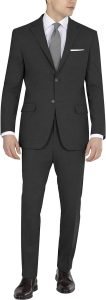
Our Recommended Men’s Suits
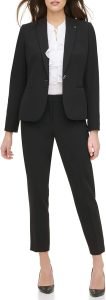
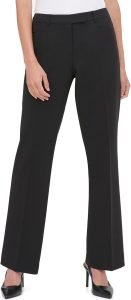
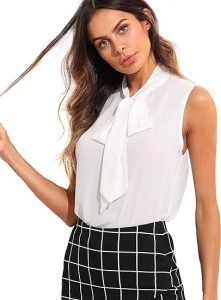
Our Recommended Women’s Suits
If you are looking for comprehensive Residency Interview Preparation Resources📦 for Match 2026/2027, including 250+ residency interview questions, samples to perfect answers for medical residency interview preparation and much more, click here.
Dress Shirt or Blouse
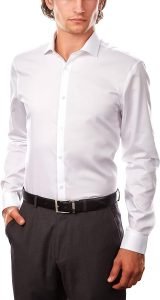
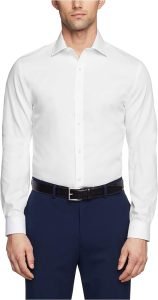
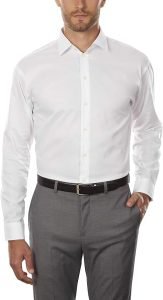
A solid-colored dress shirt for men and blouse for women is the best choice. White is the most traditional choice, but light blue or other shades can work depending on the color of the suit. Again, avoid loud, bright colors.
Similar to the suit, it’s important that the shirt fits your body type. Men’s dress shirts come in classic and slim fits. Please see the section above for a discussion on the difference between these fits. Additionally, men’s dress shirts will also be sold with different neck sizes and sleeve lengths. Your shirt should align with your body’s measurements. Avoid buying dress shirts that come in predefined sizes (e.g., small, medium, large) as it’s very unlikely the neck size and sleeve length will fit your body appropriately.
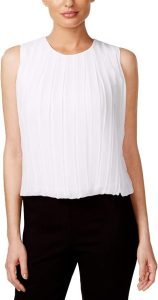
For women’s blouses, you should avoid velvet and shimmery fabrics. Cotton, silk, and blends are the best fabric choices. It’s recommended to check it in different lighting to make sure it’s not overly sheer. Additionally, make sure the blouse is not too tight and has an appropriate neckline (showing cleavage is not appropriate).
It’s important that your suit jacket, shirt (or blouse) and trousers (or skirt) be clean and well kept. This means no wrinkles, stains, or defects in the fabric such as loose threads or moth-eaten holes. For this reason, it may be worthwhile to invest in a garment bag (to protect your suit and reduce wrinkles) and a small handheld steamer. The latter may be particularly useful as hotel irons can be unpredictable and potentially damage your suit.
If you are looking for a comprehensive ALL-IN-ONE Application Resource for MATCH® 2026/2027, including ERAS application template, personal statement examples, MSPE samples, LOR examples, and much more, click here.
Our Recommended Men’s Dress Shirts
Our Recommended Women’s Dress Shirts and Blouses
Shoes
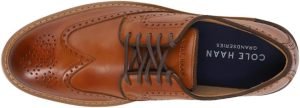
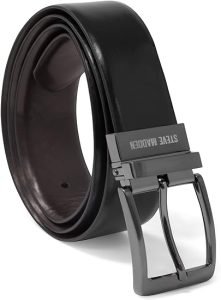
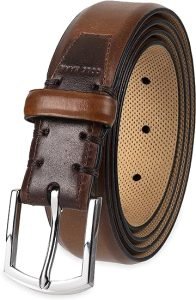
Freshly polished, lace-up, leather shoes are the standard for men. The traditional color choice is either black or a shade of brown. The appropriate shoe color is dependent on the color of the suit you’re wearing. Black suits should only be paired with black shoes, gray suits can be paired with either black or brown shoes and navy suits should only be paired with brown shoes. Importantly, your shoes should be the same color as your belt. Due to the numerous shades of brown that exist, it’s recommended to buy a pair of shoes and a belt from the same collection to ensure the colors match.
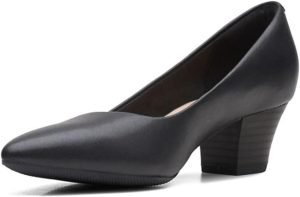
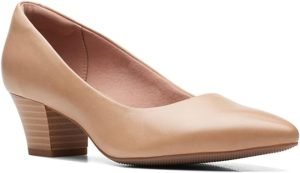
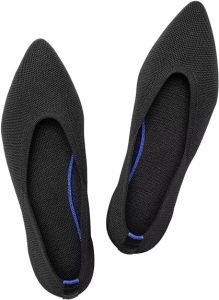
For women, your shoes should be leather, fabric or microfiber. Appropriate colors are black, navy, brown, tan and taupe and should coordinate with your other attire and accessories. For the most conservative look, toes should be covered. Excessive straps, stilettos, chunky heels and platforms are not appropriate.
Your shoes should not have any notable scuffs or marks. Make certain your shoes are broken in and that you can walk comfortably (remember, you’re going to be wearing them for the entirety of your interview day). Your choices reflect your judgment.
Looking for a comprehensive Residency Interview resources with 250+ questions and samples of perfect answers for medical residency?
Grab your FREE Interview Prep Resources here!
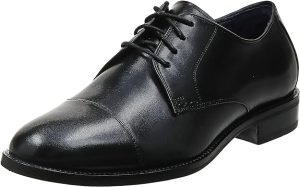
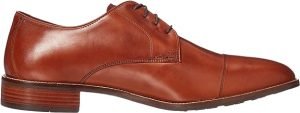
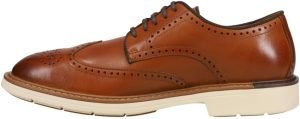
Our Recommended Men’s Dress Shoes
Cap Toe Design | Wingtip Design |
Our Recommended Men’s Belts
Black Belt | Brown Belt |

Personal Statement Editing
Our editing includes not only language but also context, structure, and content advising.

ERAS Application Editing
The editing goes beyond language and grammar corrections to structure, design, and content based on your personal story and achievement.

Interview Preparation
The best way to learn something is to do it. That’s why we divide our interview preparation sessions into two parts.
Mock Interview + Feedback

Residency Advising
We are able to provide you with the guidance you need at any step of your journey to make it to your final goal!

Ties
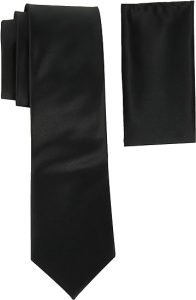
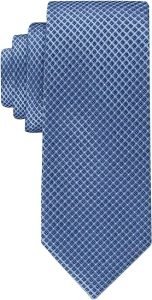
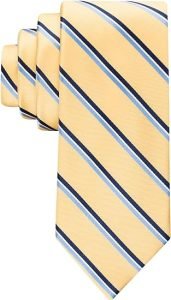
While simple solid colors are often the best choices for suits and dress shirts, your tie provides an opportunity to introduce some color and pattern into the mix. A bow tie might seem like a unique style choice, but these are generally considered less professional and should be avoided. The best color choices for ties are black, blue, burgundy, gray, white, and yellow or a combination of these colors.
Solid color ties (excluding white and yellow) are always a safe bet! Striped ties are quintessential business style and can add a lot of personality to your outfit. That said, you should limit it to a two tone striped tie so that your interview, and not your tie, does the talking. On that same note, foulard ties have become a lot more trendy recently. Their unique geometric prints allow you to really differentiate yourself from other interviewees; however, if you’re less familiar with professional styling these can be harder to appropriately select. You should stay away from floral and paisley patterns for interviews.
There are also many different knots that can be tied. A four-in-hand knot is generally considered too casual and should be avoided. Your best choices are either the Full Windsor or Half Windsor knot. The Full Windsor knot is a large, well-balanced, symmetrical knot and is generally considered to be the most formal type of knot. The Half Windsor is a medium-sized knot that is more formal than the four-in-hand and less formal than the Full Windsor. Since this knot is smaller than the Full Windsor, it requires less fabric and may be preferred by tall men.
The length of your tie is very important. It should end right on the belt line, not slightly above or below. It will likely take numerous tries to get the right length, and it is imperative that the tying be repeated until the correct length is achieved. Lastly, ties come in many different fabrics, but there is no doubt that silk is the best choice for an interview.
Our Recommended Men’s Ties
Solid Print | Geometric Print | Striped Print |
Tommy Hilfiger Men’s Core and Exotic Stripe TIe |

Practice interviewing with our experts who trained at top-notch residency programs!
Socks
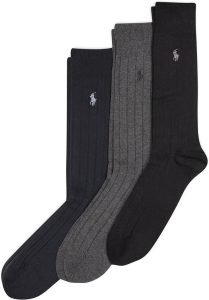
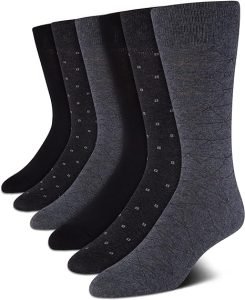
You should wear dress socks and not your day-to-day crew socks to an interview. The main difference between the two is the fabric used. Crew socks are made from thicker, rougher fabric, while dress socks are made from thinner, smoother fabric. The main purpose of dress socks is to look good, while crew socks seek to provide better support and sweat absorption. Additionally, crew socks cut off around 6 inches above the ankle whereas dress socks typically extend 9-12 inches above the ankle.
Traditionally, dress socks were just meant to compliment your suit, with muted and darker colors; however, in recent years, more vibrant and patterned dress socks have been growing in popularity. When choosing a sock, don’t go overboard. Your socks should not distract from the rest of your outfit. If you’re going for a more traditional look, your socks should be the same color as your trousers and at least one shade darker. When in doubt, black or navy blue socks are never wrong! Whatever you choose, do not wear white crew socks.
Our Recommended Men’s Dress Socks
Looking for a comprehensive ERAS Application Template with examples of diverse experiences and publication types?
Grab your FREE ERAS Template right here!
Hair, Makeup, and Jewelry
Make sure that all of your hair, including facial hair if applicable, is well-groomed, neat, and professional. For women, the same goes for nails, which, if polished, should be done in a neutral color and should be cut to a reasonable length so as not to impair function (i.e., the ability to hold your resume or other objects). A light, day-time makeup look with neutral-light lipstick is preferable. Make sure that you confirm your makeup also looks good via your webcam feed as things can appear different sometimes. Avoid heavy or bold makeup looks. It’s also important to keep jewelry at a minimum. Wedding bands/engagement rings are perfectly acceptable to wear. A small necklace and earrings are also acceptable as long as it does not distract from the overall picture. A nice, formal watch can be fine (Apple and Fitbit are also acceptable) but is not necessary. Women may also consider a small-medium purse/handbag to carry with you on interview day to carry with you on interview day in case of touch ups or to hold other small items such as writing utensils and breath mints. For men, cufflinks are acceptable (if the dress shirt permits), but again these should be subtle and professional.
Get access to 250+ residency interview questions, samples of perfect answers for medical residency interview preparation and other resources!
Claim your FREE Interview Preparation Resources here!
Other Considerations
While the main components of your attire, such as the suit and dress shirt or blouse, are crucial, it’s the subtle details that can make or break your overall presentation. If you’re fond of wearing perfume or cologne, apply it lightly or consider skipping it altogether. Some individuals are sensitive to strong scents, and you wouldn’t want to cause discomfort to your interviewers. Tattoos, piercings, and other personal expressions, may need some consideration during interviews. It’s generally recommended to cover visible tattoos and limit piercings to conventional ones, like simple ear studs. This doesn’t mean compromising who you are, but rather showing adaptability and respect for diverse professional environments.
Attire for the Welcome Reception, Pre-Interview Dinner, or Cocktail Hour
The evening before many medical residency interviews often features a welcome reception or cocktail hour, an informal prelude to the formalities of the next day. While this event provides a more relaxed environment to interact with potential colleagues and learn about the institution, it’s vital to remember that you’re still making an impression. Men might consider wearing a smart-casual blazer or sport coat with a dress shirt (tie is not required) and a pair of well-fitted chinos. Women can opt for a dress (around knee length) or a blouse with dress pants. Your outfit should be along the lines of business-casual, appropriate but not as formal as your actual interview day outfit. Closed-toe, comfortable shoes are a must, as you might be standing or walking for an extended period. While this is a more relaxed event, it’s still within the professional realm, so avoid overly casual attire like jeans, sneakers, or T-shirts. Think of this reception as a bridge between your casual self and your professional self; it’s an opportunity to show adaptability while maintaining a polished appearance. That said, some programs will want this to be more casual and, if this is the case, they will explicitly tell you to dress casually in the invite email.
If you are applying to the Match and need a detailed guide on how to ace your ERAS application, check out our free ERAS Application Guide here.
For those gearing up for their first interview, don’t miss our interview preparation packages! There are different tiers of interview preparation that include real-time mock interview and feedback about your performance! 100% satisfaction guaranteed! All by expert physician advisors! Learn more Here!
And don’t forget to grab your Free Residency Interview Questions and Answers Guide Here.
Good Luck with your residency interview and don’t hesitate to reach out to us for any questions.
Michael Trisler; James Fisher; Shriya Tanti


2026 Residency Personal Statement The Ultimate Guide to Crafting Your Residency Personal Statement

Best Resources for USMLE STEP 1! How to Study and Prepare for STEP1?

ERAS Application 2026 Guide! How to Fill Out ERAS Residency Application?
RECOMMENDED ARTICLES
ERAS Application 2026 Guide!
Personal Statement Samples Blog
Letters of Recommendation for ERAS and Residency Applicants