

If you want our team to help you with your Residency Application, click here.
Psychiatry is becoming a more competitive specialty though historically an IMG-friendly speciality in the U.S. medical system. Matching successfully requires more than just high USMLE scores. In this comprehensive guide, we’ll break down everything you need to match into a psychiatry residency from test scores and clinical experience to interview skills and research.
Whether you’re starting your USMLE journey or about to apply through ERAS, this is your one- stop roadmap to matching into Psychiatry.
Psychiatry is considered IMG-friendly with relatively high match rates compared to other specialties. According to the 2025 NRMP data:
| Applicant Type | Total Applicants | Matched | Match Rate |
|---|---|---|---|
| US MD Seniors | 1,705 | 1,433 | 84% |
| US DO Seniors | 694 | 542 | 78.1% |
| US IMGs | 329 | 153 | 46.5% |
| Non-US IMGs | 409 | 190 | 46.4% |
The match rate was calculated by dividing the number of matched applicants by the total number of applicants for each applicant type, then multiplying by 100 to express it as a percentage.
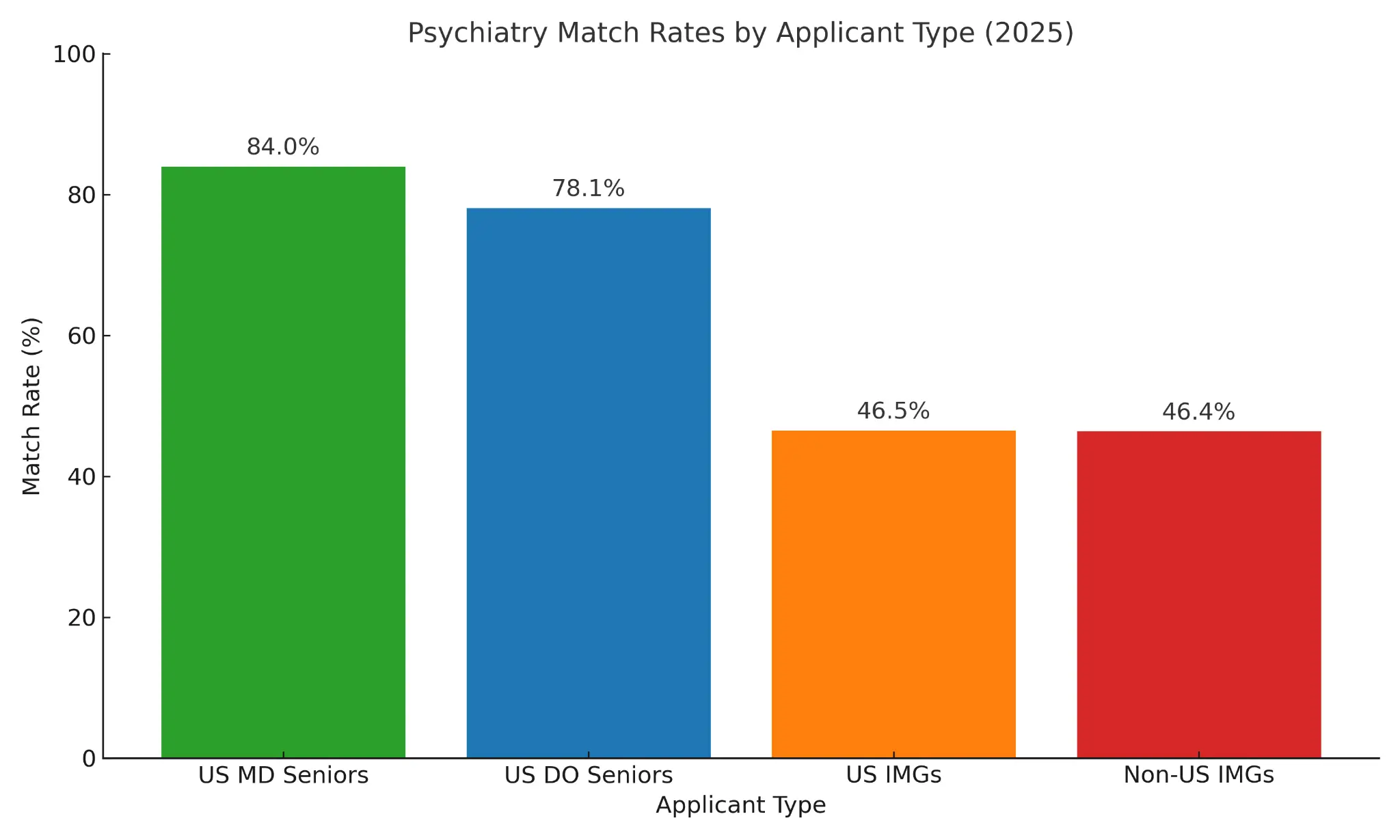
Source: NRMP
The table below highlights trends in Psychiatry residency positions and how they were filled by different applicant groups over the past three years.
| Year | Positions Offered | Filled by U.S. MD Seniors | Filled by U.S. DO Seniors | Filled by U.S. IMGs | Filled by Non-U.S. IMGs |
|---|---|---|---|---|---|
| 2025 | 2,388 | 1,433 | 542 | 153 | 190 |
| 2024 | 2,261 | 1,323 | 500 | 178 | 185 |
| 2023 | 2,164 | 1,343 | 403 | 202 | 149 |
When it comes to residency applications, many programs use standardized exam scores as an initial screening tool. Step 1 historically held the most weight in this process but with its shift to a pass/fail scoring system, the spotlight has moved to Step 2 CK. That said, it’s still crucial to pass Step 1, as a failure can significantly hurt your chances of matching.
Step 2 CK has become a crucial component of the evaluation process. While a high score doesn’t necessarily equate to better clinical skills or guarantee that someone will be a more competent physician, it does speak volumes about an applicant’s work ethic and determination. A strong Step 2 CK score shows:
Target Step 2 CK Score: 240+ is generally competitive for psychiatry. However, applicants with strong clinical experience and communication skills have matched with slightly lower scores.
The table below shows the average Step 2 CK scores for applicants who successfully matched in 2024. These scores offer a helpful benchmark for understanding how your performance compares to other matched candidates.
| Applicant Type | Avg. Step 2 CK Score (Matched) |
|---|---|
| US MD Seniors | 246 |
| US DO Seniors | 240 |
| US IMGs | 231 |
| Non-US IMGs | 240 |
Source: NRMP 2024 Charting Outcomes
While these averages provide a general overview by applicant type, Step 2 CK expectations can vary significantly by specialty. You can read our blog on the average scores by specialty here.
If your Step 2 CK score wasn’t as strong as you’d hoped, Step 3 offers a chance to turn things around. A solid performance on Step 3 can serve as evidence of resilience, growth, and your ability to bounce back and improve.
Passing Step 3 before applying can give IMGs an edge, showing readiness and easing concerns for program directors, especially for those years out of school. Since psychiatry isn’t a core medical field, applicants may risk losing general clinical skills needed for the exam.
However, do not take the exam lightly. We’ve seen applicants attempt Step 3 hoping to boost their chances, only to fail ultimately hurting their application even more. If you decide to take Step 3 before matching, make sure you’re fully prepared to pass.
✅ While not everyone is a naturally strong test taker, there are numerous resources available to help boost performance, including our personalized USMLE tutoring services, designed to help you break down complex topics, master high-yield concepts, and develop test-taking strategies. Start with a free session here.
You can check out our Biostatistics Course here.
If you’re applying to Psychiatry, gaining U.S. clinical experience (USCE) is not just helpful, it’s essential. These experiences can significantly boost your chances of matching, especially for international medical graduates (IMGs). We expand on that aspect on our USCE for IMGs blog here. The more U.S. clinical exposure you have, the more comfortable programs will feel about your readiness to function in their healthcare system.
USCE comes in various forms, each offering a unique level of engagement and value:
USCE can also be classified based on the setting:
Both are meaningful, and what matters most is how you show up during these experiences.
No matter the type or setting, the value of USCE comes from your level of engagement. Being proactive can leave a lasting impression:
These moments allow you to showcase your clinical reasoning and communication skills—qualities that letter writers can highlight in your Letters of Recommendation (LORs). Strong LORs from U.S. physicians based on your performance in clinical settings can make a big difference in your ERAS application.
At the end of the day, residency is a hands-on clinical job. You’ll be interacting with co-residents, attendings, and patients daily. USCE gives you the chance to practice those real-world skills, demonstrate your adaptability, and prove that you’re ready to contribute from day one.
So our advice? Do as much USCE as possible. Every experience adds to your confidence, credibility, and competitiveness.
📌 Need help finding clinical experience? Explore our USCE opportunities catalogue or contact us to discuss your needs.
While psychiatry doesn’t require extensive research, it can boost your application for academic programs. One of the beauties of this specialty is that it stimulates your curious mind. There are still a lot of things not yet concluded in findings such as diagnosis, treatment and management. Adding to literature through reviews and analysis can add tremendous value to the field. You as an applicant can also give yourself the opportunity to start making a niche for yourself. You can focus on case reports and reviews such as scoping review and systematic reviews. You may want to start with one or two publications which will set you apart. You may want to get involved in conducting research under a well-known psychiatrist who may advocate for you during the applications. This may also be an opportunity to receive mentorship for career advice and direction.
Being involved in research shows more than academic curiosity. It reflects:
These are all traits that align perfectly with the expectations of a resident especially in Psychiatry, where intellectual curiosity and lifelong learning are core values. Get access to the free lessons of our research course HERE.
Another major benefit of research is its potential to lay the foundation for future specialization. If you’re considering fellowship down the line, research in your area of interest can:
Whether you’re interested in Child and Adolescent Psychiatry, Geriatric Psychiatry, Addiction Psychiatry, or another psychiatry subspecialty, early involvement in research can lay a strong foundation for future fellowship opportunities. Demonstrating scholarly activity not only strengthens your residency application but also shows a commitment to advancing mental health care, qualities that are increasingly valued as the field evolves to meet complex patient needs.
Whether your title is research assistant, fellow, trainee, coordinator, or something else, what truly matters is your contribution and initiative. Be proactive:
Visibility and productivity are key. The more active you are, the more valuable your experience becomes not only for your CV but also for your professional growth.
When planning your path to residency, it is essential to think ahead and establish a clear timeline for securing research opportunities. We strongly encourage candidates, especially those who have completed medical school and clinical experiences to actively seek research positions during any available time.
Doing research during these periods adds significant value to your application, as discussed earlier. To make the most of this time and avoid gaps in your CV, keep the following tips in mind:
📣 Many successful applicants recommend doing at least 6–12 months of research between graduation and Match if possible, especially if you want to match at academic programs.
But choosing the right mentor is key. That is why we made a whole course that teaches you how to find the best mentor at the best institutions to help you achieve your career goals. Get access HERE.
The table below shows the average number of research experiences reported by matched applicants in the 2024 NRMP match data.
| Applicant Type | Mean # of Abstracts, Presentations, and Publications |
|---|---|
| US MD Seniors | 7.5 |
| US DO Seniors | 3.8 |
| US IMGs | 3.4 |
| Non-US IMGs | 8.0 |
In the NRMP data, the “mean number of abstracts, presentations, and publications” includes all scholarly work applicants reported on their ERAS application, including posters, oral presentations, and peer-reviewed articles.
Source: NRMP 2024 Charting Outcomes
Research experience demonstrates much more than academic achievement. It’s a powerful reflection of your work ethic, intellectual curiosity, and dedication to medicine. Whether you’re aiming to match into a community or academic program, your research background especially when combined with clinical exposure can elevate your application and open doors for future opportunities.
So wherever you are in your research journey: be proactive, be productive, and make it count.
Letters of Recommendation (LoRs) are among the most influential components of your residency application. Most Psychiatry programs require at least three letters, but some may ask for four and ERAS allows you to submit a maximum of four per program. These letters offer programs an outside perspective on your readiness to thrive in residency and often play a decisive role in interview selections.
Ideally, your LoRs should come from U.S.-based physicians who have worked with you directly in clinical settings. The most impactful letters are written by attendings who can comment specifically on your clinical skills, communication, personality, professionalism, and work ethic. A vague or generic letter won’t carry nearly the same weight as one that offers detailed, personal insight into your strengths and contributions.
Sub-Is or inpatient psychiatry rotations provide stronger opportunities to showcase clinical decision-making and teamwork. These clinical sites are great opportunities for trainees to engage with the team and show enthusiasm about the specialty.
Be proactive: Participate in as much as you are allowed to do. Do a mental status exam and present to your preceptors. Repeat many of these clinical steps for your mastery and for their observance of you. Then at some point ask attendings if they’re comfortable writing a strong, specific letter.
That said, you can also consider asking a research mentor to write one of your letters especially if you’ve worked closely with them over time. A research mentor can provide a window into your non-clinical strengths like teamwork, intellectual curiosity, perseverance, attention to detail, and productivity. These qualities are just as important in residency and can round out your application. You can learn more about Letters of Recommendation for ERAS and Residency Applicants here.
No matter who you ask, the key is to choose letter writers who know you well and are likely to write a personalized, enthusiastic letter. A strong, detailed letter often gets mentioned during interviews faculty might say, “Your attending said you were one of the most dedicated students they’ve worked with” or “Your research mentor described how quickly you learned and took ownership of your work.” These direct quotes shape how programs view you, sometimes more than your scores or grades.
In short: choose wisely, build relationships early, and always aim for strong, personalized letters that speak to the kind of resident and future physician you’ll be.
A strong personal statement can set you apart from other applicants with similar credentials by sharing your unique story, what drives you, the experiences that shaped you, and why you’re a great fit for the program.
Your personal statement is a valuable opportunity to:
If you are interested in a certain area of Psychiatry, this would be a good place to mention this as it gives programs an idea of potential areas of interest.
Keep in mind:
Your personal statement can also be brought up during residency interviews. Interviewers may ask you about it in detail.
Use it as a tool to express your character, personality, and your fit for Psychiatry.
An excellent personal statement requires careful thought and attention to detail.
For more tips, in-depth guidance, you can read our Ultimate Guide to Crafting Your Residency Personal Statement. If you want examples of what an excellent Personal Statement should look like, sign up to our free match resources and get 20+ personal statement examples delivered to your inbox (sign up here).
Explore our Personal Statement Editing Service Here or bundle it with the Match Application Package for a full application review experience.
Your ERAS CV (including Experiences and Publications) is a crucial part of your Match application and serves to highlight your unique skills and accomplishments.
When completing your ERAS application, it’s important to understand the different types of experiences you can list. These include:
While clinical and research experiences are the main focus, adding a variety of other experiences can provide a more comprehensive view of your character, skill set, and prior achievements. You can also use these to highlight the unique qualities you bring to a residency program.
For example:
Be strategic:
You can also check out our detailed blog posts that break down each section of the application and the types of experiences you should include. Read HERE.
If you are looking for a full ERAS Application Template including samples of Experiences, Education, Geographic Preferences, Publications, and Personal/Biographic Information, sign up here!
Need expert 1-on-1 help perfecting your ERAS Application? Check out our ERAS Editing Service or Our Match Application Packages for comprehensive support.
When it comes to applying for Psychiatry residency, especially as an International Medical Graduate (IMG), two critical strategies can significantly increase your chances of matching: applying strategically and applying broadly.
Focus on programs that fit your specific application:
As an IMG, it’s important to recognize that competition is steep, and not all programs have the same level of openness to international applicants. For these reasons, casting a wide net is not only recommended, it’s essential.
The more you apply, the more likely you are to get interviews but be mindful of application costs, which can be significant.
▶️ Check out our video on how many programs to apply to based on the NRMP® and AAMC® data.
Once you’ve secured interviews, the next phase is equally crucial: interview performance.
A strong application may get you through the door, but how you present yourself in interviews often determines your final rank. Programs are not only assessing your knowledge they’re asking: Would I want to work with this person for the next four years?
Start your interview preparation with our 200+ residency interview questions, and sign up to our interview prep resources to get sample answers to these questions (sign up here).
To support you through this crucial stage, we offer one-on-one interview preparation sessions through The Match Guy, led by experienced advisors who understand what programs are looking for. Our Interview Prep service ccan be tailored for Psychiatry applicants, where you’ll be matched with a Psychiatry Interview Preparation advisor. They are designed to simulate real residency interviews (mock interviews) and provide personalized feedback, helping you feel confident and well-prepared.
Psychiatry is a comprehensive medical specialty focused on the evaluation, diagnosis, and treatment of mental, emotional, and behavioral disorders across all ages and life stages. Psychiatrists are trained to manage a wide spectrum of psychiatric conditions, utilize both psychotherapy and pharmacologic treatments, and often develop deep, long-term therapeutic relationships with their patients. This specialty offers the flexibility to practice in a variety of settings including outpatient clinics, hospitals, community mental health centers, correctional facilities, academic institutions, and underserved areas. Psychiatrists can also pursue fellowships in areas like Child and Adolescent Psychiatry, Geriatric Psychiatry, Addiction Psychiatry, Forensic Psychiatry, and Consultation-Liaison Psychiatry.
Training typically involves a 4-year residency that emphasizes biopsychosocial approaches, comprehensive diagnostic evaluation, psychotherapy training, and continuity of care for patients with complex and chronic mental health needs. Psychiatry offers a uniquely rewarding experience grounded in human connection, curiosity, and the transformative power of healing. Some of the key advantages include:
In essence, psychiatry offers a dynamic, patient-centered training experience that prepares physicians to care for diverse populations in diverse settings. Whether your goal is community practice, inpatient care, policy work, academic leadership, or fellowship training, psychiatry provides the depth, flexibility, and human connection to make it possible.
A strong application opens the door. Nailing your interviews walks you through it.
Together, these two strategies can be the difference between a good match cycle and a great one. So do your homework, prepare thoroughly, and don’t underestimate the power of being thoughtful, honest, and professional in every interaction.
And remember The Match Guy team is here to help you every step of the way. Check out our Match Guy Residency Match Application Package to access personalized interview preparation, expert human editing, one-on-one advising, and all the tools you need to maximize your chances of matching successfully.