
If you want our team to help you with your Residency Application, click here.
Embarking on a journey to secure a residency position in Emergency Medicine (EM) as an International Medical Graduate (IMG) presents unique challenges and opportunities. With meticulous preparation and a strategic approach, IMGs can successfully navigate the competitive landscape of matching into Emergency Medicine through the National Resident Matching Program (NRMP).
The NRMP facilitates the residency placement of medical graduates into U.S. training programs through a structured matching algorithm. Applicants submit their preferences via the Electronic Residency Application Service (ERAS), which streamlines the application process by allowing candidates to apply to multiple programs simultaneously.
The Council of Residency Directors in Emergency Medicine (CORD) is an organization that publishes EM-specific guidance and standards for EM residency applications. CORD frequently updates these EM residency application standards which are adopted by program directors, program applicants, and residency advisors each cycle. More importantly, CORD is the organization responsible for providing guidance on the centralized emergency medicine standardized letters of evaluation.
Analyzing recent data provides insight into the competitive nature of EM residencies:
| Year | Positions Offered | Filled by U.S. MD Seniors | Filled by U.S. DO Seniors | Filled by U.S. IMGs | Filled by Non-U.S. IMGs |
|---|---|---|---|---|---|
| 2025 | 3,068 | 1,377 (45%) | 1,078 (35%) | 315 (10%) | 131 (4%) |
| 2024 | 3,026 | 1,285 (42%) | 1,047 (35%) | 325 (11%) | 123 (4%) |
| 2023 | 3,010 | 1,274 (42%) | 730 (24%) | 289 (10%) | 61 (2%) |
| 2022 | 2,921 | 1,593 (55%) | 753 (26%) | 176 (6%) | 45 (2%) |
| 2021 | 2,840 | 1,765 (62%) | 790 (28%) | 143 (5%) | 35 (1%) |
| 2020 | 2,665 | 1,713 (64%) | 683 (26%) | 155 (6%) | 30 (1%) |
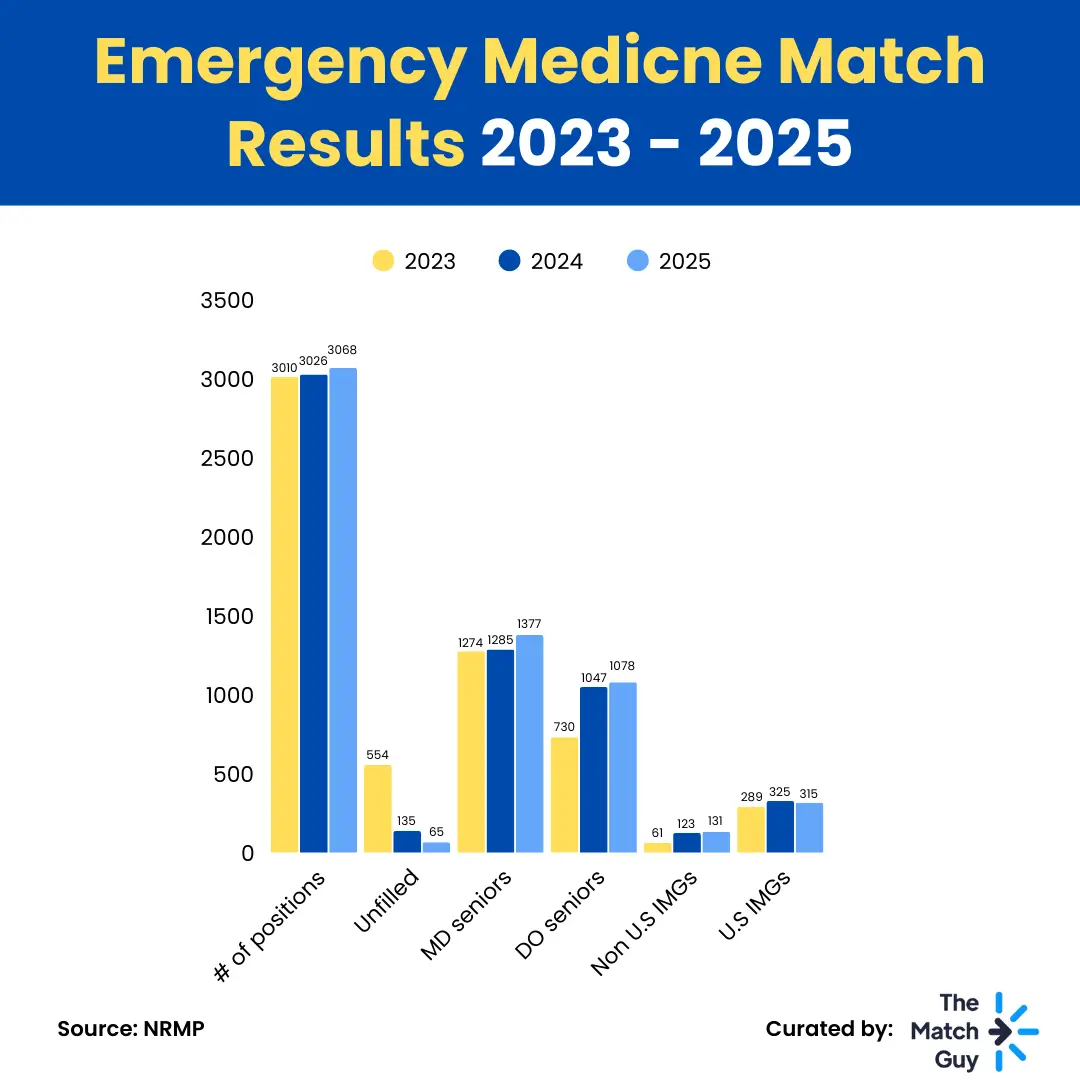
This data underscores the increasing presence of DO applicants in EM residencies, reflecting a significant upward trend in recent years. nrmp.org
| Applicant Type | Total Applicants | Matched | Match Rate |
|---|---|---|---|
| US MD Seniors | 1,514 | 1,377 | 90.95% |
| US DO Seniors | 1,231 | 1,078 | 87.57% |
| US IMGs | 467 | 315 | 67.45% |
| Non-US IMGs | 336 | 131 | 38.99% |
The match rate was calculated by dividing the number of matched applicants by the total number of applicants for each applicant type, then multiplying by 100 to express it as a percentage.
If instead you would like to sign up for an all-in-one package where we would edit your Personal Statement, ERAS Application, give you Advising on the MATCH® and prep you for Interviews, you can ➡️ Explore That Here.
A pivotal component of the EM residency application is the Standardized Letter of Evaluation (SLOE). Program directors have ranked SLOEs to be the most important factor in determining potential residents. This letter provides a comparative assessment of an applicant’s performance relative to their peers. The authors of SLOEs vary depending on the type of SLOE provided. cordem.org
CORD has provided EM residency applicants with guidance that candidates should acquire two eSLOEs, ideally one at a home institution and another at an away institution. A third letter can be any variation of the SLOE or a typical letter. Student Advising Guide
To strengthen your candidacy for an EM residency, consider the following strategies:
Clinical experience within the U.S. is essential to successfully matching into an emergency medicine residency program. These experiences allow you to acquire SLOEs, network with academic physicians within EM, and further develop your CV.
For IMGs, obtaining a SLOE or US clinical experience can be challenging for a number of reasons. It is advisable to proactively seek out EM rotations at institutions with residency programs to secure this critical component of the application. A number of resources exist to help applicants meet this requirement including VSLO and EMRA Clerkship Match. Most programs begin accepting applications in March and process them in April. For guidance on securing such experiences, refer to resources on United States Clinical Experience for IMGs.
Aim for high scores on the United States Medical Licensing Examination (USMLE) Step 1 and Step 2 Clinical Knowledge (CK) to enhance your competitiveness.
There is a notable correlation between the number of research experiences and successful matching outcomes. U.S. IMGs who matched into their preferred specialty reported an average of 2.1 research experiences. Non-U.S. IMGs who matched reported an average of 2.8 research experiences. nrmp.org
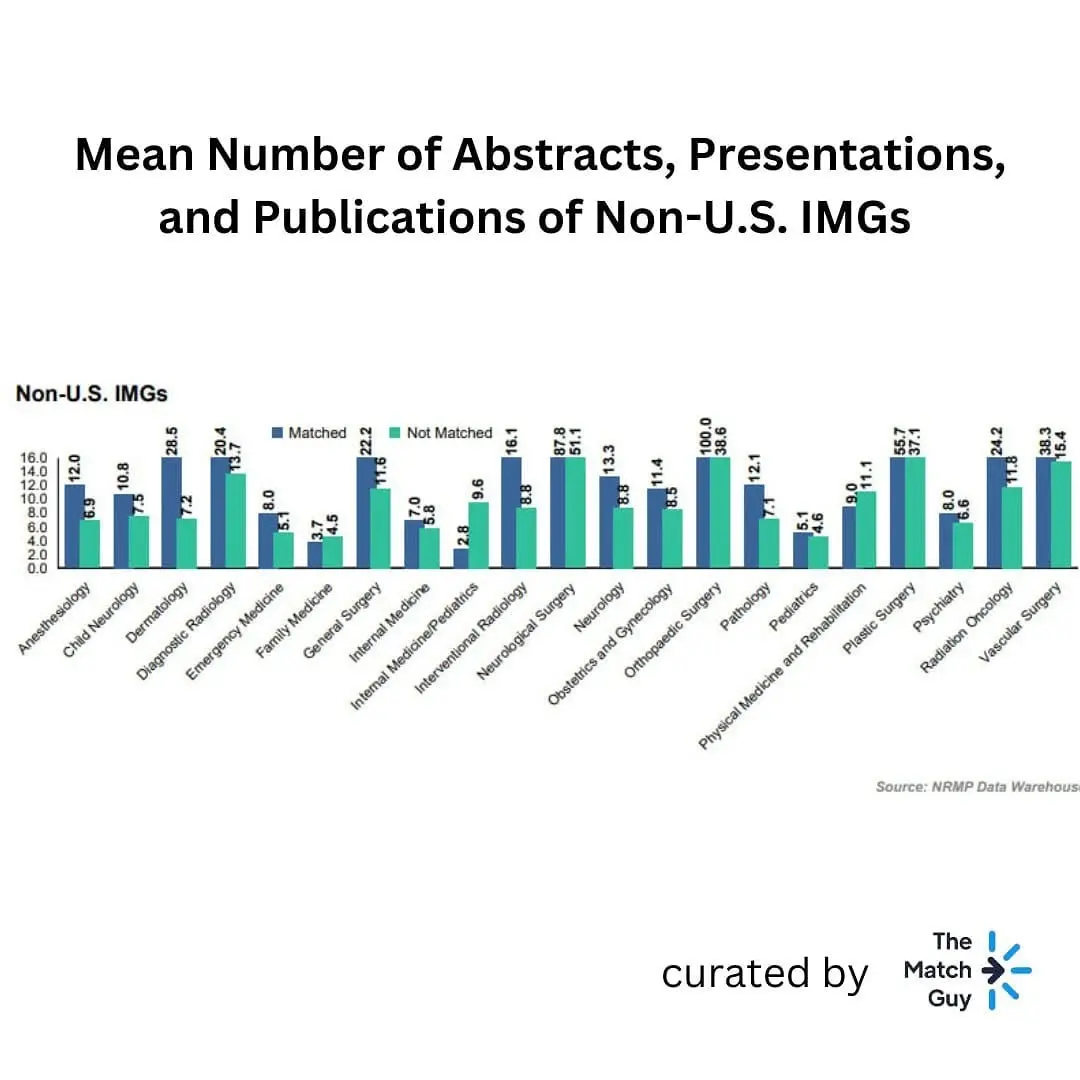
A strong research portfolio can open doors for non-U.S. IMGs. Know the average numbers and strive to surpass them, your hard work counts! 🧠📝
Build relationships with EM professionals through conferences, workshops, and professional organizations. Mentorship can provide valuable guidance and open doors to opportunities. Aim to attend the ACEP Scientific Assembly in September, an annual conference that many residency programs will attend to network with prospective applicants. This is a great opportunity to ask questions and makes for a great interview ice-breaker. Social media has become an increasingly popular way for programs to showcase themselves to prospective applicants. It’s also a great way to connect with current residents in the program, ask them questions and express your interest in the program. Read our guide on Networking with Residency Programs for a Successful Match.
With nearly 290 EM programs scattered throughout the U.S., it’s important to carefully choose which programs to apply. Prioritize programs that you share a connection with (programs in a state you grew up in, programs within your signaled geographic preference, and programs that are IMG friendly). Research programs on social media and residency explorer to identify IMG friendly programs.
Craft a compelling and memorable personal statement that articulates who you are and your passion for EM. Prepare for each individual interview well in advance to effectively convey your strengths and convince programs why you want to join their program. Consider reviewing our Sample Residency Interview Questions and Answers.
Reach out to residency programs throughout the interview season to express your genuine interest in their particular program. Share why you think their program is a good fit for your personal and professional goals (i.e. You might have family in the area, you may have lived in the city while pursuing an undergraduate degree or completing research). If you want to learn more about Letters of Interest (LOI), check out our other blog here.

Common obstacles for IMGs include:
Early identification of programs that sponsor visas and timely initiation of the visa application process are crucial.
Most hospitals and medical schools require visiting students to have malpractice insurance and an affiliation agreement between the two institutions in place. Inquire if your medical school will be able to provide you with a certificate of insurance if required by host institutions. Affiliation agreements can take weeks to months to finalize if not already established between the two institutions.
Familiarize yourself with the U.S. healthcare culture and communication styles to ensure effective interaction with patients and colleagues.
Ensure that your medical credentials are accurately translated and recognized by relevant U.S. authorities.
Pursuing a residency in Emergency Medicine as an IMG is a challenging yet attainable goal. By strategically enhancing your application, securing strong evaluations, and effectively navigating the match process, you can position yourself for success in this dynamic field.
In a survey of all EM program directors, eSLOEs were one of the top factors in determining whether applicants were extended an interview. CORD strongly recommends that all EM applicants have two eSLOEs from institutions with an EM residency program. If your medical school does not have an affiliated EM residency, it is encouraged that complete two elective EM rotations at other institutions with an EM residency program. It can be challenging to obtain two eSLOEs, especially if you are an IMG. If unable to obtain two eSLOEs, applicants should discuss next steps with an EM residency advisor.
Despite not being as critical as having two eSLOEs, pursuing research opportunities are a great way to make your application stand out among applicants with comparable scores, and academic performance. Partaking in research enables applicants to network with academic physicians at the hospital sponsoring the research project but also at conferences you plan to present at. If you’re interested in learning more about how to get involved in research, check out our blog post here.
There are many situations that might make you an “at-risk candidate.” Late-comers to EM, IMGs, couples match applicants, or failing a medical school course increases your risk of not matching to EM. Applicants are encouraged to talk to an advisor specific to EM as soon as possible to help mitigate risk and optimize chances of matching.
Applying to residency is challenging and can be very stressful at times. Our advisors have extensive knowledge of the residency application process, the Match and EM-specific application requirements. Our EM-residency advisors will provide personalized advice along the entire process after reviewing your specific situation to help you achieve your goals. Our advisors are prepared to keep you on-track, offer personal statement and ERAS CV feedback, prepare you for interviews, and navigate challenges with being an IMG, couples matching, or having red-flags on your application. Schedule your free consultation today.
By Dr. William DaSilva