

USMLE Blog
STEP 3 Best Resources: How to Study for STEP 3?

I hope you enjoy reading this blog post.
If you want our team’s expert help with your USMLE prep, click here
Updated December 2025
Step 3 can be a challenging exam—especially because people often prepare for it during residency, with far less dedicated study time than they had for Step 1 and Step 2. With this time crunch, studying efficiently and effectively becomes essential.
This blog post is designed to point you to the most effective, high‑yield resources so you can focus your time where it matters and avoid getting lost in too many materials.
You don’t have to tackle Step 3 alone. Our full course provides clear explanations and high-yield notes designed to boost your confidence. Enroll today.
If you need a personalized strategy or one-on-one expert guidance to push past your plateau, we’ve got you covered. Explore Our Expert USMLE Tutoring to get paired with a top-scoring physician and achieve your target score efficiently.
Table of Contents
- What is the format of the Step 3 Examination?
- What are the core resources for effective Step 3 studying?
- How do I choose a question bank for USMLE Step 3?
- How do I use the question banks effectively?
- What are the USMLE Step 3 CCS Cases?
- What are the best resources for the USMLE Step 3 CCS?
- What assessment tools are available?
- How do I use the assessment tools effectively?
- Are there specific resources for biostatistics?
- How Long Does It Take to Prepare for Step 3?
- How can I prepare as quickly as possible for USMLE Step 3?
- USMLE Step 3 timing for IMGs: H-1B Visa Sponsorship
- FAQs
- Final Advice for Students Studying for Step 3
What is the format of the USMLE Step 3 Examination?
Step 3 is the final exam in the USMLE sequence. It tests whether you can apply foundational science and clinical knowledge in the context of independent practice, including diagnosis, management, and patient safety across inpatient and outpatient settings.
Step 3 is administered over two days. The first day consists of 6 blocks of multiple-choice questions (232 questions, 38-39 questions per block) on the Foundations of Clinical Practice with topics ranging from basic medical and scientific principles, biostatistics, and ethics (7 hours of testing total, including breaks). The second day consists of 6 blocks of multiple-choice questions (180 questions, 30 questions per block) on Advanced Clinical Practice with questions emphasizing diagnosis, management, prognosis, health screening, and medical decision making, followed by 13 computer-based case simulations (9 hours of testing total, including breaks).
You can find more information on the structure of the Step 3 exam on the USMLE website here: USMLE.org
What are the core resources for effective Step 3 studying?
Whether your goal is to simply pass the exam or to obtain the highest score possible, you will need to utilize three core resources in your exam preparation. These include:
- A high-quality question bank to prepare for the MCQ portion of the exam.
- An interactive platform to prepare for the CCS cases.
- Practice assessments to evaluate your progress and preparation for exam day.
In addition to the above resources, 1-on-1 tutoring, the Step 3 Biostatistics and the 7-day Step 3 Bootcamp can help accelerate your exam preparation and emphasize the high-yield areas on which to focus your studying.
The next few sections will outline our recommendations for question banks, CCS case preparation, and practice assessments.
How do I choose a question bank for USMLE Step 3?
The question bank is your main resource for exam studying, so it is essential that you select one of high quality. The two “gold-standard” question banks are UWorld and AMBOSS. Details regarding these question banks, including their pricing and content, are shown below:
| Step 3 QBank | Cost for 3-month membership | Number of questions | Practice Exams | CCS Cases |
| UWorld | $429 | 2100+ | 2 (4 blocks, 160 questions each) | 50+ interactive + 40+ read-only |
| AMBOSS | $338 | 2000+ | 0 | 0 |
Note: Updated Dec 2025. Question counts, included features, and pricing change periodically. Verify the latest details on each provider’s official product page before purchasing.
To summarize, UWorld has the full package of practice questions, practice exams, and CCS cases all in one spot.
If you decide to go with AMBOSS, you will need to use another resource to study the CCS cases (see CCS case resources section below). Subscription to the AMBOSS question bank also gives you access to their medical library and integrated Anki add-ons.
There are often promos/discounts available, so keep an eye out for these.
Not sure whether UWorld or AMBOSS is the better Qbank for you? Read our full comparison on our blog UWorld Vs. AMBOSS.
How do I use the question banks effectively?
Working through the question banks, especially during residency with limited time, can be challenging. Studying these well will save you time and streamline your exam preparation.
Our recommendations to help get the most from your question bank are to:
- Use subject-specific blocks to target your weak subjects first if you have limited time.
- Read the full explanation (including why wrong answers are wrong) and capture only the key takeaways in a brief note system you will actually review.
- If you cannot finish the full question bank, prioritize high-yield internal medicine, OB/GYN, pediatrics, surgery, and outpatient management topics plus biostatistics and ethics.
- Use timed blocks as much as possible, especially closer to your test days, to refresh yourself on the timing/pacing of the exam.
You can read our blog on how to study UWorld here.
What are the USMLE Step 3 CCS Cases?
CCS (Computer-based Case Simulations) are interactive cases where you:
- Receive a brief clinical scenario and vitals.
- Order a physical exam (focused or complete).
- Request labs, imaging, and procedures.
- Start and adjust treatments.
- Monitor the patient over simulated time.
- Provide counseling and decide on disposition (admit, transfer, discharge, follow-up).
They are designed to test your clinical reasoning, prioritization, and ability to manage a patient over time rather than just picking a single answer choice.
For a comprehensive overview and detailed approach to the CCS cases, see this blog Step 3 CCS Cases: How to Tackle the Computer-Based Case Simulations.
Ace Your Step 3 with Expert Guidance
Struggling with Step 3 preparation? Get personalized 1-on-1 coaching from top scorers and experienced mentors.
What are the best resources for the USMLE Step 3 CCS?
It is important to practice working through these cases on a platform which mimics the Primum software used by the USMLE. The best resources to prepare for the CCS cases include:
UWorld Step 3 CCS cases
- If you decide to go with UWorld for your Qbank, the CCS cases are included with your subscription.
- UWorld includes 90+ CCS cases total, including 50+ interactive cases and 40+ ‘read-only’ cases on classically tested scenarios.
The Match Guy Step 3 CCS Course
- Walk-throughs of real cases on the actual CCS-style platform, showing exactly how to:
○ Enter orders
○ Advance the clock
○ Decide when to admit/transfer/discharge - About a few hours total – efficient way to understand the software mechanics and “flow” before grinding through cases.
- Learn more here.
CCScases.com
- Large bank of CCS-style cases with written feedback and a (non-validated) scoring system.
- Good for volume and variety, but don’t over-interpret their “scores.”
- 3 month subscription for $90.
USMLE official CCS software + free practice cases
- Downloadable from the USMLE website (Primum software).
- Includes several practice CCS cases with written feedback but no numerical score.
Check out this video for the ultimate Step 3 CCS guide.
What assessment tools are available?
Common assessment options include:
NBME Comprehensive Clinical Medicine Self-Assessment (CCMSA)
- Multiple forms available, each with 200 questions.
- $62 per assessment.
USMLE Free Sample Questions
- USMLE provides a 137-question sample test (often called the ‘Free 137’), and CCS software practice cases.
- Review the Free-137 explanations from The Match Guy after completing here
- CCS practice cases come with written feedback but do not provide a numerical performance score.
UWorld Step 3 Self-Assessment 1 and 2
- Four blocks of 40 questions each.
- You can also purchase these separately from the UWorld Qbank ($50 each or $80 for both).
There is currently no fully validated CCS “predictive” self-assessment; most formal scoring is still based on the MCQ portions.
How do I use the assessment tools effectively?
Using assessment tools early and often is the best way to monitor your progress and identify problem areas prior to your exam. Many students wait until the last few weeks to start taking practice exams after they have reviewed all the content. We feel that this is a missed opportunity to evaluate your progress and more efficiently target your weaknesses during your exam prep.
Are there specific resources for biostatistics?
There is a particular emphasis on biostatistics questions on the Step 3 exam (11-13% of total questions), so this is an area that deserves adequate attention during your preparation. Resources available for biostatistics include:
UWorld Biostatistics Review
- Although there are biostatistics questions contained within the main UWorld and AMBOSS Qbanks, this can be an additional resource if you need more practice.
- Contains 70-75 additional questions covering all necessary concepts for the biostatistics section.
- $25 for 90-day access.
The Match Guy Biostatistics Course
- A focused biostatistics course with quizzes/exercises and monthly live webinars; available in 1-month, 3-month, and lifetime access packages.
- Best use: complete it early (even in a half-day) to cover high-yield biostats/epidemiology, then reinforce with Qbank questions.
- If you struggle with abstracts and study interpretation, prioritize this resource and re-practice calculations/definitions until automatic.
- Learn more here.
Crush the Biostatistics of USMLE STEP 1, STEP 2 CK, and STEP 3 exams

How Long Does It Take to Prepare for Step 3?
This will depend on your goals.
If you are a matched resident looking just to pass the exam, you can take a more focused studying approach to ensure you are confidently passing the exam in the least amount of time.
If you are looking to score high for one reason or another (for example, if you’re an unmatched applicant looking to improve your application), you will likely need to take a more comprehensive and methodical approach to your exam preparation.
Additional considerations include the amount of time it has been since you took Step 1 and Step 2, as well as how well you performed on these exams.
Typical prep time:
- Roughly 2–8 weeks depending on:
○ Your goals for the exam (e.g. passing or scoring high)
○ Your prior performance on Step 1 and Step 2 CK.
○ How recently you took those exams.
○ Your workload (e.g., residency schedule).
Whatever your timeline, do not neglect biostatistics, ethics, and CCS practice – if forgotten, these can cost you a significant number of points on test day and may make the difference between passing and failing.
Check out this video to learn how to pass Step 3 in just 3 weeks.
How can I prepare as quickly as possible for USMLE Step 3?
If you are in a hurry: a focused 3-week plan can be enough for many residents if your Step 2 foundation is solid and you can study consistently (often by using a lighter rotation or vacation days).
A simple 3-week framework:
- Days 1-15: The Step 3 bootcamp + UWorld daily (as many blocks as your schedule allows). If time is tight, start with weak subjects/systems first and save mixed blocks for later.
- Days 16-18: One or two self-assessments + targeted review of your weak areas.
- Days 19-21: Rapid review of your notes/missed concepts + CCS practice to lock in speed and the order-entry workflow.
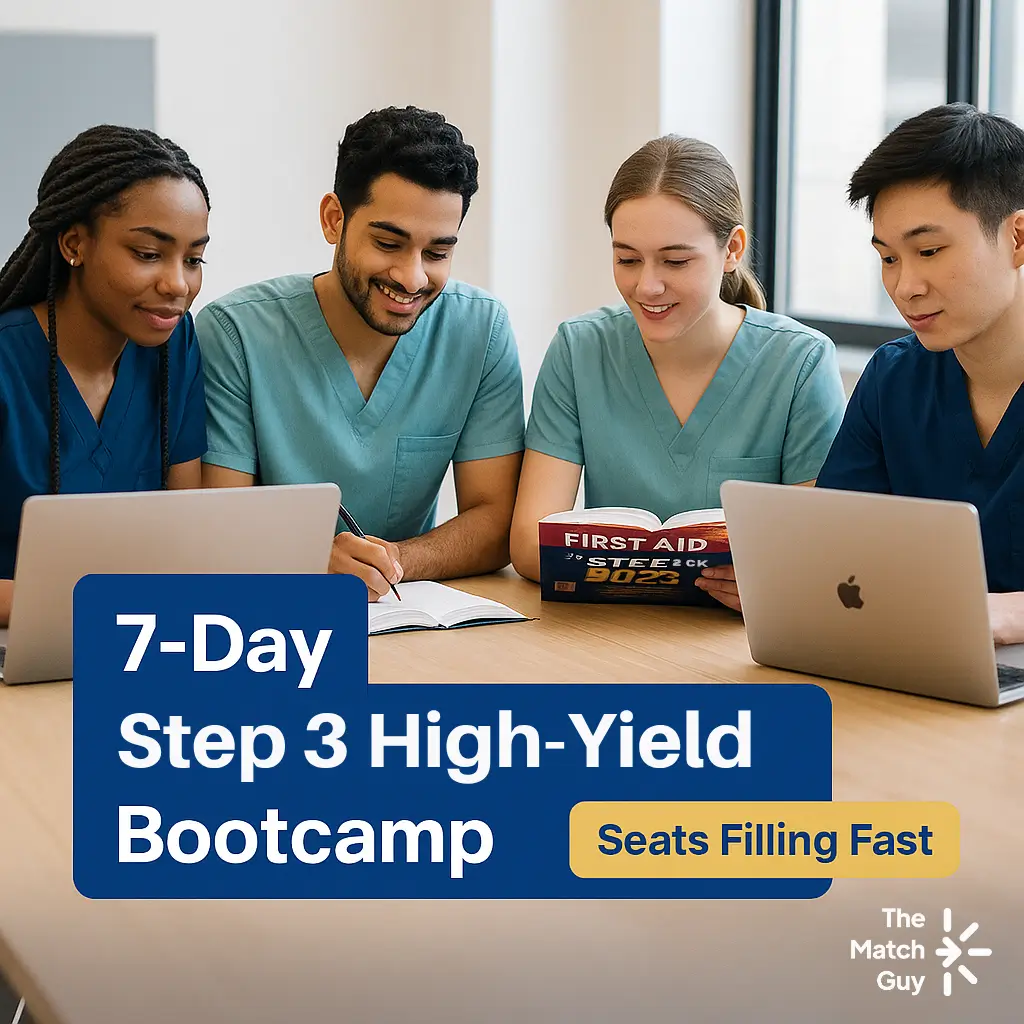
The Step 3 bootcamp is helpful specially for busy residents or IMGs trying to refresh their knowledge as it goes through all high-yield concepts for MCQs of Step 3 in 7 days, with an additional day dedicated to CCS, giving you a clear overview of the entire exam in just one week. If it’s not the right fit, it comes with a money-back guarantee.
For those who need to expedite their studying and need extra support, especially after a prior exam failure, 1-on-1 tutoring can help save hours spent studying fringe topics and trying to figure out what is high yield. Read this blog on who benefits from tutoring here.
The Match Guy USMLE Step 3 High-Yield Bootcamp (8-day)
- 7 days of live, interactive teaching (~50-60 total hours), focused on commonly tested Step 3 topics (and one day focused on CCS cases)
- Includes access to session recordings, so you can review later or catch up if you miss a day.
- Best use: build a high-yield foundation up front so you can move through UWorld faster or quick review before the exam.
- Not a replacement for questions. Use it to guide what you emphasize when reviewing your Qbank misses and weak areas.
USMLE Step 3 timing for IMGs: H-1B Visa Sponsorship
Quick disclaimer: visa rules and institutional policies vary a lot, and immigration timelines can change year-to-year. Treat this as planning guidance, not legal advice. Your program’s GME office + immigration counsel will be the final word.
If you’re planning to match into an H-1B–sponsoring program, you should aim to pass Step 3 by Match Week and have your results available by that time. Because Step 3 results can take up to three weeks, this usually means starting your preparation in January and scheduling the exam early enough to receive your score before Match Week (mid-March).
If you match into an H-1B–eligible program without Step 3 completed on time, you will most likely be placed on a J-1 visa, which carries the two-year home residency requirement.
On the other hand, if you are planning to pursue a J-1 visa, completing Step 3 before starting residency does not affect your visa status.
FAQs
What are the Eligibility Requirements for the USMLE Step 3 Examination?
To be eligible for Step 3, you must:
- Have a medical degree (MD/DO or international equivalent).
- Have passed Step 1 and Step 2 CK.
- For IMGs, typically hold ECFMG certification.
Check the official USMLE and ECFMG sites for the most up-to-date rules and documentation requirements.
What are the Passing and Average Scores for USMLE Step 3?
The current passing score is 200 (increased from 198 for exams taken on or after January 1, 2024).
Recent Step 3 mean scores are ~227 (SD ~15) for first-time test takers (varies slightly by year).
- Your score report breaks performance down by:
○ Organ system
○ Physician tasks
○ CCS cases (computer-based case simulations)
The passing threshold is periodically reviewed, so confirm on the USMLE website before you take the exam.
Check out this video to learn how to study for USMLE Step 3, featuring a 267 Step 3 experience.
Does the USMLE Step 3 Score Matter?
- For most specialties, a Step 3 score near the mean is sufficient.
- Programs and fellowships generally care more about:
○ Clinical performance
○ Letters of recommendation
○ Research and other accomplishments
That said:
- A strong Step 3 score can sometimes help offset weaker earlier scores.
- The most important thing is passing on the first attempt.
Do You Need USMLE Step 3 for Residency?
- You do not need Step 3 to apply to or start most residency programs.
- Some applicants choose to take it before or early in residency, especially if:
○ They want to strengthen their application after lower Step 1/2 CK scores.
○ Their specialty or specific program encourages having it done early.
Is USMLE Step 3 Hard?
- Conceptually, it is generally considered less difficult than Step 1 or Step 2 CK.
- However, it has unique challenges:
○ Balancing studying with residency.
○ Learning CCS software and time management. - Adequate preparation and CCS familiarity are still crucial.
How much does the USMLE Step 3 cost?
The current cost of the Step 3 exam is $955 for 2026. This cost typically goes up annually. Check here for the most up-to-date cost information.
Final Advice for Students Studying for Step 3
- Use your chosen Qbank as your main resource.
- Consider the Step 3 bootcamp to expedite your learning.
- Practice CCS cases regularly so the format feels automatic.
- Take practice assessments early and regularly to target your weak areas.
- Consider supplementing with:
○ A CCS-focused course
○ Additional resources for biostatistics
○ Tutoring if you’re stuck or short on time - For busy residents or IMGs, taking the exam earlier (when your knowledge is fresher) can save you stress later.
If you need help with USMLE Step 3 tutoring or having an expert guide you through high-yield concepts and test strategies, don’t hesitate to reach out to us HERE!
If you have any questions about any of our services, don’t hesitate to reach out to our customer support service here.
Best of luck on your exam prep!
By Liam Locke, MD
Meet your tutor — schedule a session now!
Latest Articles

2026 Residency Personal Statement The Ultimate Guide to Crafting Your Residency Personal Statement
Malke Asaad
July 8, 2024

Best Resources for USMLE STEP 1! How to Study and Prepare for STEP1?
Malke Asaad
August 12, 2022
ERAS Application 2026 Guide! How to Fill Out ERAS Residency Application?
Malke Asaad
July 13, 2023
Need Help?
About TheMatchGuy
The Match Guy is a premier medical consulting firm trusted by over 35,000 students worldwide. We help medical students and graduates excel on the USMLE (Step 1, Step 2 CK, and Step 3) and strengthen their residency applications through proven study strategies, expert tutoring, and personalized guidance from elite 260+ scoring tutors who have helped countless students achieve their goals. Whether you’re aiming for a competitive specialty or navigating the Match as an IMG, we help you prepare smarter, avoid burnout, and position yourself as a strong applicant from exam day through Match season. Schedule a FREE discovery call now.
RECOMMENDED ARTICLES
Step 1 Sample Test Answers + Explanations 2025

High-Yield USMLE Step 1 Topics You Must Know (2025)
Step 2 Sample Test Answers + Explanations 2025