

USMLE Blog
If you want our team’s expert help with your USMLE prep, click here
Preparing for the USMLE as an international medical graduate involves far more than exam fees alone. From credential verification to clinical experience, applications, and visas, the total cost adds up quickly. Understanding the full financial picture early helps you plan realistically, avoid surprises, and make smarter decisions at each stage of the journey.
This guide breaks down every major cost IMGs face in the 2025 to 2026 cycle, explains why each expense exists, and shows how they fit into the overall pathway toward US residency.
Our Free High-Yield USMLE Notes 📚 for Step 1 and Step 2 CK are built for efficient learning, ensuring you master the core concepts necessary to ace both exams, even on a tight schedule.
You can also bundle these notes with our full course, which explains the notes in-depth and covers additional high-yield concepts. Enroll today for USMLE Step 1, Step 2, or Step 3 prep.
If you need a personalized strategy or one-on-one expert guidance to push past your plateau, we’ve got you covered. Explore Our Expert USMLE Tutoring to get paired with a top-scoring physician and achieve your target score efficiently.
This is the official starting point of the USMLE journey for IMGs. These fees establish your identity, verify your medical credentials, and allow you to enter the certification system.
Costs include:
Although no exams occur at this stage, delays here can stall your entire timeline. Many applicants benefit from guidance during document preparation and verification to avoid costly errors or resubmissions.
USMLE Step 1 is the first major academic milestone in the US residency pathway. For most international medical graduates, it is also the most demanding phase of preparation. The exam tests foundational medical sciences, but success depends less on short-term memorization and more on long-term retention, pattern recognition, and disciplined study habits.
Beyond the academic challenge, Step 1 requires careful financial planning. Exam fees, preparation resources, and indirect travel costs can add up quickly, especially for IMGs testing outside the US and Canada.
For international graduates testing outside the US and Canada, the Step 1 exam fee is composed of two parts:
This fee covers registration and exam administration but does not include any preparation materials or travel-related expenses.
Most candidates use a combination of question banks, reference texts, spaced-repetition tools, and practice exams. While not every resource is mandatory, some have become near-universal due to their effectiveness.
UWorld remains the cornerstone of Step 1 preparation. It is widely regarded as the single most important paid resource because of its high-quality questions, detailed explanations, and close alignment with NBME exam style.
Current QBank-only pricing options are:
Most students choose 180 days or longer to allow for proper spaced review rather than rushed completion.
You can read our blog on how to study UWorld here.
Watch our video, “How to Study UWorld for USMLE Step 1 and Step 2 CK” to learn proven strategies for mastering the UWorld question bank.
AMBOSS is commonly used as a supplemental tool rather than a replacement for UWorld. Its strength lies in its searchable knowledge library, quick explanations, and integration with question-based learning.
Pricing varies by access length:
AMBOSS is particularly useful for clarifying weak areas and reinforcing concepts encountered during question practice.
Not sure whether UWorld or AMBOSS is the better Qbank for you? Read our full comparison on our blog UWorld Vs. AMBOSS.
Sketchy uses visual memory techniques and is especially high-yield for microbiology and pharmacology. Many students use it selectively rather than covering the entire library.
Current subscription pricing:
First Aid serves as the central reference text for most Step 1 candidates. It is often used alongside UWorld and Anki rather than as a standalone resource.
NBME self-assessments are considered the most accurate predictors of real exam performance. They are essential for readiness assessment and exam-timing practice.
Many students complete two to four forms, depending on their preparation timeline.
Anki is a free spaced-repetition flashcard tool and a core component of long-term retention for Step 1. While the software itself is free, effective use requires consistency and time investment rather than money.
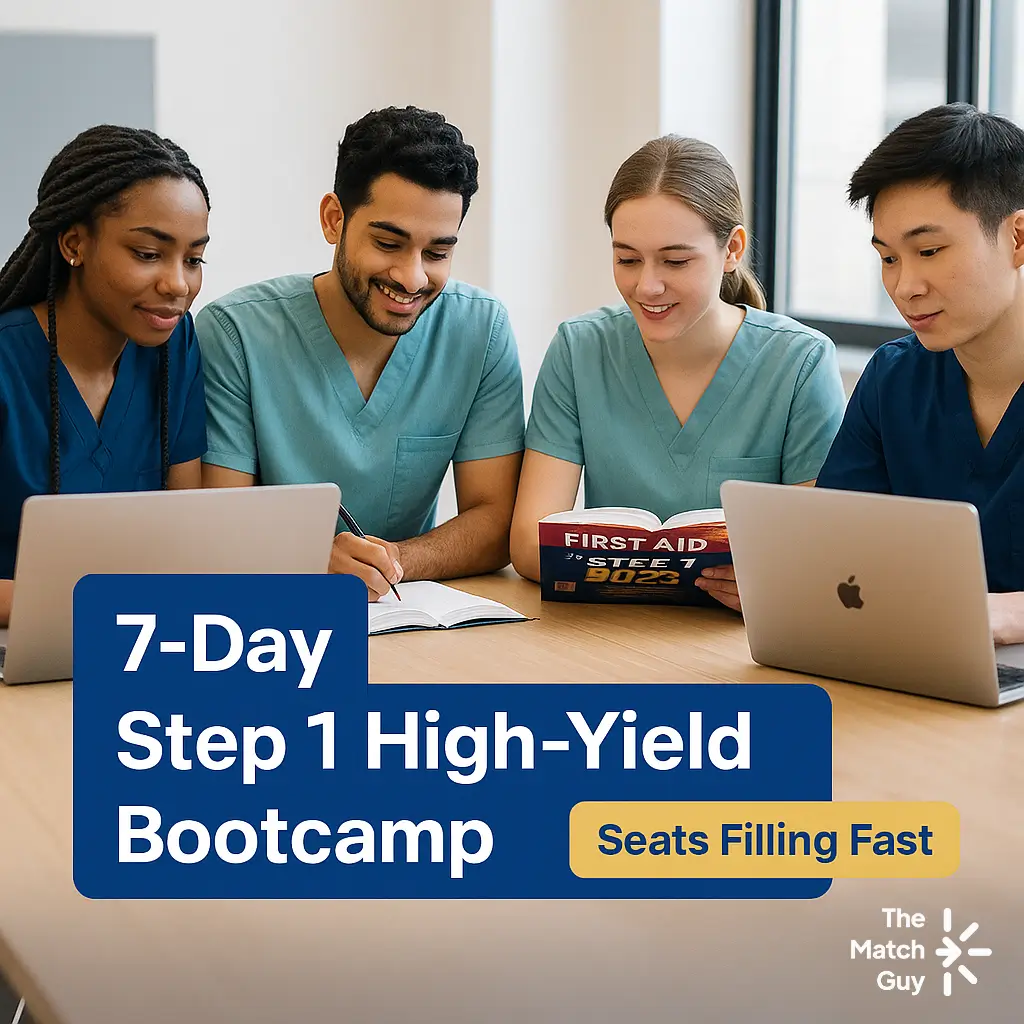
This is an optional structured review course designed to help students organize their study strategy, identify recurring NBME patterns, and use resources like UWorld and Anki more efficiently.
The bootcamp runs over seven days, focuses strictly on high-yield content, and offers a full refund if students are not satisfied after the first session.
A frequently underestimated expense for IMGs is testing center location. Unlike US graduates, many international candidates must travel to another city or even another country to sit for the exam.
Additional indirect costs may include:
Depending on location and availability, these costs can easily add several hundred dollars to the overall Step 1 budget. Planning early is critical, especially when nearby Prometric slots fill quickly.
🎥 Watch this video: “ USMLE STEP 1 Study Plan: How to Pass in 2 Months ” a roadmap covering the best resources and strategy for your Step 1 prep.
At the lower end, a minimalist but effective setup might include:
At the higher end, a more comprehensive preparation plan could include:
USMLE Step 2 CK is arguably the most critical numerical benchmark in the residency application. For international medical graduates, the transition from Step 1’s “Pass/Fail” logic to Step 2 CK’s high-stakes scoring requires a fundamental shift in strategy. Success on this exam demands not just medical knowledge, but advanced clinical reasoning, the ability to manage time under the pressure of longer vignettes, and an understanding of the evolving “Systems-Based Practice” questions.
Beyond the academic rigor, navigating the financial and administrative logistics of Step 2 CK is a significant undertaking. From regional surcharges to the new registration portals launched in 2026, IMGs must plan their journey with both a clinical and a financial roadmap.
For international graduates testing outside the US and Canada in 2026, the Step 2 CK exam fee is composed of two parts:
Key 2026 Budgeting Notes
Most students build Step 2 CK around a question bank plus NBME-style self-assessments. Optional add-ons can improve workflow, but they are not required for a strong score.
UWorld is commonly treated as the “must-have” paid resource for Step 2 CK because it anchors your prep to high-volume, exam-style clinical reasoning with detailed explanations.
Common QBank pricing tiers (QBank-only; includes Shelf Exam Review, and defined numbers of UWorld self-assessments depending on length):
AMBOSS is often used to target weak areas and to quickly look up clinical details while doing questions.
Pricing options commonly listed for Step 2 CK prep:
To gauge your readiness for Step 2 CK, you need to navigate two main types of practice materials. Here is the current count and cost as of 2026:
These are the full-length practice exams that provide a three-digit predicted score and a probability of passing.
These are subject-specific ‘mini-exams’ (50 questions each) designed to assess mastery of core clinical clerkships and provide targeted feedback on subject-level performance across 8 key disciplines: Internal Medicine, Surgery, Pediatrics, Obstetrics & Gynecology, Psychiatry, Family Medicine, Clinical Neurology, and Emergency Medicine.
The Match Guy’s 7-day Step 2 CK Live Bootcamp offers 50-60 hours of intensive, high-yield tutoring and interactive question review to help students and IMGs master exam concepts and strategy.
If your testing center is far, you may need:
For many IMGs, this adds several hundred dollars and can materially change the real Step 2 CK budget, especially when nearby slots are limited.
These examples use the official exam fee plus common resource bundles. Your true total depends mainly on how long you need UWorld access, how many NBME forms you do, and whether travel requires flights and hotels.
Watch our video, “USMLE STEP 2 CK in 2 months”.
English proficiency is demonstrated through OET Medicine, which focuses on real clinical communication rather than academic English.
Although smaller than USMLE fees, this step is mandatory and must be passed to proceed with ECFMG certification.
US clinical experience is often the largest single expense but provides exposure to US healthcare systems, letters of recommendation, and networking.
Estimated costs for three months:
Careful selection of rotations is essential. Poor-quality placements can be expensive without adding real value to an application.
Because U.S. clinical experience requires a major financial commitment, many IMGs look for curated and transparent options before committing. The Match Guy offers structured U.S. clinical experience rotations, clearly outlining available settings, expectations, and logistics to help applicants make informed decisions.
Using structured information when comparing rotations can help avoid high-cost placements that add limited educational or application value.

The ECFMG Pathways application confirms completion of exams, OET, and credential requirements.
This is one of the final administrative steps before residency applications open.
To better understand the differences between the available ECFMG Pathways and how to choose the appropriate option, you can watch our detailed explainer Youtube video.
Some IMGs choose to complete Step 3 before residency, especially if visa timing or program preferences favor it.
Costs:
While Step 3 is optional, passing it can strengthen an application in certain cases. If you are unsure whether taking Step 3 is actually a smart move for your specific situation, you could consider scheduling an advising session with The Match Guy to discuss whether Step 3 is a particularly good idea for you based on your visa plan, timeline, specialty targets, and current application strength.
The Match Guy also offers a focused 7-Day USMLE Step 3 High-Yield Bootcamp, designed specifically for IMGs who want rapid review of high-yield concepts, CCS strategy, and exam-day approach.
Applying broadly is expensive, especially for IMGs.
Typical costs for 150 programs in one specialty:
Strategic application planning can significantly reduce unnecessary expenses.
Practical “most people need” range:
Most seasons are still heavily virtual, but a few programs may offer in-person interviews, second looks, or optional visits. If you decide to go, it can get expensive fast, so plan like you are doing a short weekend trip.
A realistic budget per trip often looks like:
A simple way to estimate the total per trip:
These costs occur late in the process but must be budgeted in advance.
These expenses sit outside the USMLE pathway, but they are real and often become the biggest financial pressure point between matching and starting residency.
These costs are not part of the formal USMLE process, but they are part of the reality of relocating for residency. Planning for them early can reduce financial stress during an already demanding transition and help you start residency on more stable footing.
Watch our video, “J1 Visa for Residency in the USA”.
When all major steps are completed, the approximate total cost of the USMLE journey for an IMG is: 25,000 – 30,000 USD
This number varies based on exchange rates, location, exam attempts, and application strategy, but it provides a realistic baseline for planning.
Ideally before registering with MyIntealth, as costs accumulate early and continuously.
No, but it significantly improves match chances.
Yes, through careful resource selection, strategic applications, and avoiding unnecessary rotations or exam retakes.
No, but it is required for H-1B visa sponsorship, and some programs prefer or prioritize applicants who have already passed Step 3.
US clinical experience typically represents over half of total costs.

The total cost of the USMLE journey for IMGs in the 2025 to 2026 cycle is driven by several big buckets: ECFMG and credentialing setup, Step 1 and Step 2 CK exam fees plus prep resources, OET Medicine, ECFMG Pathways, U.S. clinical experience, and residency application costs through ERAS and NRMP. Optional add-ons, especially Step 3 and paid courses, can increase the total, but the major swing factors are how much U.S. clinical experience you pursue, how broadly you apply, how many practice assessments you buy, and whether you need international travel for Prometric testing.
The real challenge for most IMGs is not any single fee, but the cumulative effect of many required steps stacked across a long timeline. Planning early helps you avoid rushed purchases, short subscriptions that force inefficient studying, last-minute travel costs, and expensive mistakes that delay your cycle. A realistic budget should assume variability, keep a buffer for logistics and unexpected requirements, and prioritize preventing setbacks because a retake, a missed deadline, or a poorly chosen rotation can cost more than any single study resource.
If you need help with USMLE tutoring or having an expert guide you through high-yield concepts and test strategies, don’t hesitate to reach out to us HERE!
Free high-yield notes for USMLE Step 1 and Step 2, covering essential must-know concepts.
You can also bundle these notes with our full course, which explains the notes in-depth and covers additional high-yield concepts. Enroll today for USMLE Step 1, Step 2, or Step 3 prep.
If you have any questions about creating a personalized study schedule that integrates your chosen resources, don’t hesitate to reach out to our team. We’re here to support you every step of the way.
Best of luck on your USMLE journey!
By Michael Azeze Negussie